Chamarajanagar District, Karnataka: Wildlife, Temples, Forests, History & Travel Guide
Karnataka’s southernmost district sits at one of the most ecologically and culturally significant junctions in peninsular India. To the west, the Western Ghats begin their descent toward Kerala. To the east, the hills roll into Tamil Nadu’s Dharmapuri and Krishnagiri districts. Between them, Chamarajanagar holds a landscape that has been shaped equally by ancient dynasties, Veerashaiva saint traditions, tribal communities who have inhabited these forests for millennia, and a wildlife corridor that today functions as one of the most critical elephant and tiger habitats on earth.
The district was formerly known as Sri Arikottara and was renamed Chamarajanagar after Chamaraja Wodeyar — the Mysore king who was born here. Carved from the larger Mysore district in 1997, it encompasses four taluks (with Hanur added later), covering a landscape of dry deciduous forests, rocky hills, river valleys, and dense wildlife sanctuaries. Bandipur National Park and Tiger Reserve, Biligiri Rangaswamy Temple Wildlife Sanctuary (BRT), Male Mahadeshwara Wildlife Sanctuary, and the Cauvery Wildlife Sanctuary together make Chamarajanagar one of the most wildlife-dense districts in Karnataka.
Chamarajanagar District, Karnataka — Quick Overview
| Feature | Details |
| State | Karnataka |
| District Headquarters | Chamarajanagar town |
| District Formed | 15 August 1997 (carved from Mysore district) |
| Area | 5,685 sq km |
| Location | Southernmost district of Karnataka |
| Borders | Mysore (W & N), Mandya & Ramanagara (NE), Tamil Nadu — Dharmapuri, Krishnagiri, Salem, Erode, Nilgiris (E & SE), Kerala — Wayanad (S) |
| Famous For | Bandipur National Park, BR Hills (BRT Wildlife Sanctuary), Male Mahadeshwara Hills, Himavad Gopalaswamy Betta, Kamsale dance |
| Key Rivers | Kaveri (Cauvery), Kapila, Suvarnavati |
| Indigenous Community | Soligas — forest-dwelling tribal community centred around BR Hills |
| Nearest Airport | Mysuru Airport (MYQ) / Kempegowda International Airport, Bengaluru (~160 km) |
| Railway Station | Chamarajanagar Railway Station (metre gauge, Mysuru–Chamarajanagar line) |
| Best Time to Visit | October to May (wildlife); year-round for pilgrimage |
| Summer Temperature | 26°C – 38°C |
| Winter Temperature | 14°C – 26°C |
| Languages Spoken | Kannada (primary), Tamil, Telugu, Malayalam |
| Key Taluks | Chamarajanagar, Gundlupet, Kollegal, Yelandur, Hanur |
History of Chamarajanagar District
Ancient and Early Medieval Period
The landscape of present-day Chamarajanagar has sustained human habitation since the Iron Age — over 20 megalithic stone circles excavated in the MM Hills area in 2013 have been dated to approximately 800 BCE. Rock inscriptions at Narasamangala and Haradanahalli record the presence of the Ganga dynasty, whose southern reach included this territory. The Hoysalas subsequently made their mark — the Vijaya Parsvanath Basadi, a Jain shrine at Chamarajanagar town, was built in 1117 AD by Punisadandanayaka, a commander of the Hoysala king Gangaraja. The Vijayanagara Empire’s temples and inscriptions are also present across the district.
The Soliga community — one of Karnataka’s most significant adivasi (indigenous tribal) groups — has inhabited the forests of the BR Hills and MM Hills area from time immemorial. Their relationship with these forests, their knowledge of the ecosystem, and their traditions of worship at the Biligiri Ranganathaswamy Temple at the hilltop are interwoven with the district’s cultural identity. The BRT Wildlife Sanctuary’s conservation model has in fact incorporated Soliga ecological knowledge — a significant example of indigenous knowledge integration in wildlife management.
Veerashaiva Movement and Male Mahadeshwara
In the 14th–15th century, the Veerashaiva saint Mahadeshwara settled on the MM Hills (Male Mahadeshwara Betta), preached the ideals of Veerashaivism, practised traditional medicine, and according to tradition attained Jeeva Samadhi (living samadhi) within the temple’s inner sanctum. The linga worshipped in the temple’s Garbha Gudi is regarded as swayambhu (self-manifested). Junje Gowda, a local landlord from the Kuruba community and a devotee of the saint, built the Male Mahadeshwara Temple. The spiritual epicentre created by Mahadeshwara’s presence continues to draw lakhs of pilgrims annually from Karnataka, Tamil Nadu, and Kerala.
Mysore Kingdom and District Formation
The region was incorporated into the Mysore Kingdom under the Wodeyar dynasty in the late medieval period. Hyder Ali usurped control in 1761 and his son Tipu Sultan ruled until his defeat in 1799. After Tipu’s death, the British restored the Wodeyar dynasty. The town of Chamarajanagar (previously Arikottara) was renamed by Krishnaraja Wadiyar III in honour of his father Chamaraja Wodeyar who was born here. The Chamarajeshwara Temple in the town was built in 1825. Chamarajanagar remained a taluk of Mysore district until 15 August 1997, when it was constituted as a separate district — one of seven new districts created by the Karnataka government on that date as a gift of the Golden Jubilee of Indian Independence.
Top Attractions in Chamarajanagar District
Bandipur National Park and Tiger Reserve
Bandipur is the flagship attraction of the district and one of India’s premier wildlife destinations. Covering approximately 874 sq km within Chamarajanagar’s Gundlupet taluk, Bandipur was one of the original Project Tiger reserves when the programme launched in 1973, starting with just 12 tigers. It is now one of the most successful tiger conservation areas in India. The park sits at the junction of three protected areas — Mudumalai (Tamil Nadu), Wayanad (Kerala), and Nagarhole (Karnataka) — forming one of the largest contiguous wildlife corridors in Asia.
The dry deciduous and teak forests of Bandipur support tigers, leopards, elephants (with one of the largest populations in India), gaur (Indian bison), spotted deer, sambar, wild dogs, and over 200 bird species. Morning jeep safaris offer the best wildlife sighting opportunities. Bus safaris within the forest core are also available. Bandipur is easily accessible from Mysuru (approximately 80 km) and Ooty (approximately 25 km across the state border) — making it one of the most convenient major wildlife parks in South India.
Safari booking is done through the Karnataka Forest Department’s official portal. Weekend and holiday slots fill up weeks in advance in the October–March peak season.
Biligiri Rangaswamy Temple Wildlife Sanctuary (BR Hills)
The Biligiri Ranganathaswamy Temple Wildlife Sanctuary — universally known as BRT or BR Hills — occupies one of the most ecologically unique positions in India. Sitting at the confluence of the Western and Eastern Ghats, BRT at 5,091 feet above sea level receives rainfall from both monsoon systems and consequently supports an extraordinary range of vegetation types within a compact area: scrub, dry deciduous, moist deciduous, semi-evergreen, evergreen, and shola forests all exist within the same sanctuary.
The Biligiri Ranganathaswamy Temple at the hilltop — from which the sanctuary takes its name — is an ancient shrine dedicated to Lord Ranganatha (Vishnu). The view from the hilltop, with the white-granite hill standing dramatically above the surrounding forest, is one of the finest panoramas in Karnataka. Wildlife within BRT includes tigers, leopards, elephants, and the Soliga community whose traditional forest lifestyle has been documented and studied internationally as a model of indigenous forest stewardship. 4WD jeep safaris into BRT require permits obtained through the forest department.
Male Mahadeshwara Hills (MM Hills)
Located in the Hanur taluk at approximately 3,200 feet above sea level, the Male Mahadeshwara Hills are the district’s most important pilgrimage destination and a major eco-tourism point. The ancient Male Mahadeshwara Temple sits within dense forest that constitutes the MM Hills Wildlife Sanctuary — which in 2013 was proposed for significant expansion to protect the elephant corridor between BRT and the Cauvery basin.
Reaching MM Hills involves navigating 18 hairpin bends through forested hillsides where elephants, gaur, and leopards are frequently seen. The temple’s darshan timings are 6 AM to 12 noon and 5 PM to 8:30 PM. Three major annual fairs are held here — during Shivaratri, Ugadi, and Deepavali — each drawing approximately one lakh pilgrims. The Car Festival (Brahma Ratha) during the major fair season is a spectacular event. The pilgrimage tradition of Kamsale — where initiated Kuruba community men perform a martial devotional dance with cymbal-like bronze discs (kamsale) while singing the seven-part epic of Mahadeshwara — is an intrinsic part of the temple experience.
Himavad Gopalaswamy Betta
About 75 km from Chamarajanagar and 56 km from Gundlupet, Gopalaswamy Betta (also called Himavad Gopalaswamy Hills) is a sacred hill dedicated to Lord Krishna (Gopalaswamy). The hill, perpetually shrouded in mist (hence Himavad — “snow-like”), sits within forest that is part of the Bandipur-Mudumalai corridor. The road to the hilltop passes through dense forest with regular elephant and deer sightings — giving visitors a wildlife experience even outside the formal safari zones. The ancient temple at the summit has panoramic views of the Nilgiris, the Deccan plateau, and the blue-green forests of the Bandipur-Mudumalai complex.
Chamarajeshwara Temple — Chamarajanagar Town
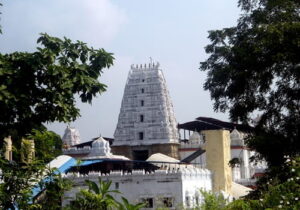
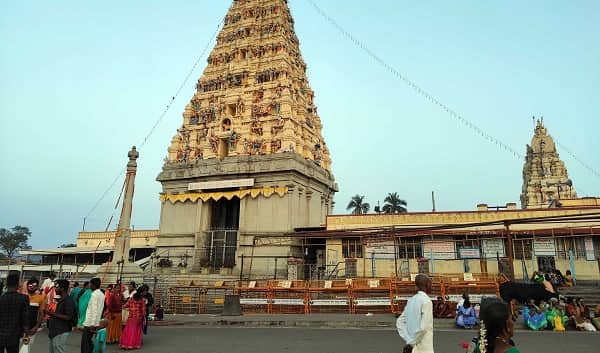
Built in 1825 by Krishnaraja Wadiyar III in the heart of Chamarajanagar town, the Chamarajeshwara Temple is dedicated to Lord Shiva and represents the Mysore Wodeyar dynasty’s religious patronage in the district. Built in the traditional Dravidian style with an elaborately carved gopuram (entrance tower) and detailed stone sculptures, the temple is one of the district’s most architecturally significant urban religious sites. The annual Car Festival here is a significant community event.
Vijaya Parsvanath Basadi — Chamarajanagar
One of the oldest structures in the district, the Vijaya Parsvanath Basadi is a Jain shrine built in 1117 AD during the Hoysala period by Punisadandanayaka, a commander of Hoysala king Gangaraja. It is the earliest dated architectural monument in the town and connects the district’s history to the Hoysala dynasty that built Karnataka’s most celebrated temples in Hassan.
Dzogchen Monastery — Near Kollegal
A Tibetan Buddhist monastery of the Nyingma school (one of the oldest schools of Tibetan Buddhism) established near Kollegal in the Chamarajanagar district. The monastery is part of the global Dzogchen lineage and adds a distinctive Buddhist cultural presence to the district’s layered religious landscape. Colourful prayer flags, traditional Tibetan architectural elements, and the meditative atmosphere of a well-maintained monastery in forest surroundings make it a contemplative alternative stop on the district circuit.
Somanathapura — Hoysala Temple (Near District Boundary)
While technically in Mysore district, the Keshava Temple at Somanathapura (a Hoysala masterpiece of the 13th century) is frequently combined with Chamarajanagar circuit visits given its proximity. The fully trikuta (three-shrined), star-shaped temple with its exquisitely dense sculptural friezes is one of the finest architectural achievements of the Hoysala dynasty.
Gopinatham Eco-Tourism
Run by the Karnataka Forest Department near the Karnataka-Tamil Nadu border, Gopinatham offers coracle rides, birdwatching, cycling, trekking, and guided nature walks in the forest fringe area near the Cauvery River. It is one of the district’s most accessible eco-tourism experiences for non-safari visitors.
Kamsale — The Devotional Martial Dance of Chamarajanagar
No cultural description of Chamarajanagar is complete without Kamsale. This devotional dance form, practised by initiated men from the Halumatha Kuruba community, involves rhythmic, high-energy movements with a cymbal-like metal disc (kamsale) in one hand and a bronze disc in the other — producing a distinctive clanging rhythm. The dance is part of a deeksha (spiritual oath) taken by practitioners and is taught by a spiritual leader within the community.
Kamsale is inseparable from the worship of Male Mahadeshwara. Pilgrims performing Kamsale sing the seven-part epic of the saint as they travel to and at the hill temple. The epic narrates the saint’s life from birth through his miraculous feats and eventual samadhi — a story that has been passed down orally for six centuries without a single printed text. Kamsale is performed at the major fairs of Mahadeshwara Hills (Deepavali, Shivaratri, Ugadi) and is one of Karnataka’s most distinctive and least-commercialised folk performance traditions.
Temples and Religious Sites of Chamarajanagar District
| Site | Location | Deity / Tradition | Key Feature |
| Male Mahadeshwara Temple | MM Hills, Hanur taluk | Lord Shiva (Mahadeshwara) | 15th-century Veerashaiva pilgrimage; Kamsale dance; forest wildlife surroundings |
| Biligiri Ranganathaswamy Temple | BR Hills summit, Yelandur taluk | Lord Ranganatha (Vishnu) | Ancient hilltop temple; BRT Wildlife Sanctuary named after it; Soliga tradition |
| Himavad Gopalaswamy Temple | Gopalaswamy Betta, Gundlupet taluk | Lord Krishna (Gopalaswamy) | Misty hilltop; elephant corridor route; panoramic Nilgiri views |
| Chamarajeshwara Temple | Chamarajanagar town | Lord Shiva | Built 1825 by Krishnaraja Wadiyar III; annual Car Festival |
| Vijaya Parsvanath Basadi | Chamarajanagar town | Jain tradition | Built 1117 AD; oldest dated monument in town; Hoysala period |
| Dzogchen Monastery | Near Kollegal | Tibetan Buddhism (Nyingma) | Oldest school of Tibetan Buddhism; colourful prayer flags; meditative atmosphere |
| Madhya Ranga Temple | Kollegal area | Lord Vishnu | Important local pilgrimage site with peaceful river setting |
| Huluganamurudi Temple | Gundlupet area | Lord Venkataramana | Historic hilltop Vaishnava shrine |
Weather in Chamarajanagar District — Season by Season
Chamarajanagar has a varied climate influenced by both the Western Ghats (particularly around BR Hills and MM Hills at higher elevations) and the drier Deccan plateau conditions at lower elevations near the town.
October to February — Best Time to Visit
The ideal window across all attractions. October and November bring post-monsoon freshness — forests are green, the Cauvery is full, and wildlife is active in Bandipur and BRT after the monsoon. December and January are cool and pleasant — morning safaris at Bandipur are particularly rewarding, and the hilltop mist at Gopalaswamy Betta and BR Hills is at its most atmospheric. February remains excellent. This is also prime season for elephant sightings on the MM Hills road.
March to May — Pre-Monsoon and Wildlife Peak
As water sources within the forests dry up, animals congregate around remaining water bodies, making tiger and elephant sightings more reliable in Bandipur. Temperatures rise to 35–38°C in the plains but remain cooler at higher elevations. The Shivaratri festival at MM Hills typically falls in February–March — the most attended fair of the year.
June to September — Southwest Monsoon
The district receives moderate to heavy monsoon rainfall, particularly at higher elevations. Bandipur National Park typically closes safari operations during the core monsoon months (usually late June to September). BR Hills and MM Hills become dramatically green and misty. Wildlife moves deeper into the forest. Road access to some hilltop temples can be disrupted.
Things to Do in Chamarajanagar District (2026)
Book a Bandipur Safari — Jeep safaris (morning and evening) must be booked in advance through the Karnataka Forest Department’s official Jungle Lodges & Resorts or online portal. Weekend slots in peak season (October–February) fill weeks ahead. Elephants, gaur, deer, and spotted owlets are reliably seen; tiger sightings are possible and meaningful when they occur.
Drive to BR Hills and the BRT Wildlife Sanctuary — The approach road through Yelandur takes you through forest with frequent wildlife sightings. The Biligiri Ranganathaswamy Temple at the summit is one of Karnataka’s most dramatically situated shrines. The sunset view from the hilltop is extraordinary.
Pilgrimage to Male Mahadeshwara Hills — The 18 hairpin bends through elephant country are themselves an experience. Arrive for the early morning darshan at 6 AM. If visiting during a major fair (Shivaratri, Ugadi, Deepavali), the Kamsale dance performances by initiated pilgrims are a cultural event of genuine importance.
Drive the Gopalaswamy Betta Road at Dawn — The road from Gundlupet through the forest to Gopalaswamy Betta offers wildlife sightings in a misty, forest-corridor setting. Plan to arrive at the temple before 8 AM when the mist is thickest and the light is most atmospheric.
Visit the Dzogchen Monastery — A quiet, contemplative stop near Kollegal. The monastery’s peaceful atmosphere and Tibetan architectural elements create an unexpected meditative oasis within the district’s predominantly South Indian temple circuit.
Gopinatham Eco-Tourism — Coracle and Forest Walk — The Karnataka Forest Department’s Gopinatham eco-tourism programme offers a structured, affordable forest experience with coracle rides on the Cauvery, guided birdwatching, and nature walks. Book through the forest department in advance.
How to Reach Chamarajanagar District
By Air: Mysuru Airport (MYQ) is the nearest functioning airport, approximately 75 km from Chamarajanagar town. Kempegowda International Airport, Bengaluru, is approximately 160 km away and is the primary international gateway.
By Train: Chamarajanagar Railway Station is on the metre gauge line connecting Mysuru to Chamarajanagar. Services are limited — confirm schedules locally. Mysuru Junction is the main railhead with broad gauge connections to Bengaluru, Chennai, and other cities.
By Road: Chamarajanagar is approximately 190 km from Bengaluru via Mysuru (NH 766). KSRTC buses connect frequently to Mysuru (approximately 60 km) and Bengaluru. The Mysuru–Ooty highway (NH 212/766) passes through Gundlupet at the Bandipur forest gate.
Practical Tips for Visitors (2026)
- Bandipur safaris must be booked online in advance — walk-in availability is minimal in peak season.
- Night driving ban: A Supreme Court order prohibits vehicles on NH 212/766 through Bandipur from 9 PM to 6 AM to protect wildlife. Plan drives accordingly.
- Wildlife viewing: Carry binoculars. Early morning (6–9 AM) and late afternoon (4–6 PM) give the best sightings. Avoid loud noises and sudden movements.
- Chamarajanagar district is designated a tobacco-free zone — no smoking or chewing is permitted in tourist areas.
- The district is also noted for cleanliness standards in its eco-tourism zones — carry out all waste.
- At MM Hills, heavy traffic during major festivals (Deepavali, Shivaratri) can make approach roads significantly congested — plan arrivals for the day before or after peak.
Conclusion
Chamarajanagar is the kind of district that compresses an extraordinary range of experience into a relatively compact geographical area. You can watch elephants at a forest waterhole at Bandipur in the morning, be at a hilltop temple surrounded by mist and ancient devotional music by midday, visit a Tibetan monastery in the afternoon, and encounter a Soliga community’s forest traditions by evening. The wildlife, the pilgrimage culture, the indigenous heritage, and the sheer ecological drama of this Western-Eastern Ghats junction landscape make Chamarajanagar one of Karnataka’s most multidimensional district experiences.
FAQs About Chamarajanagar District, Karnataka
Q: What is Chamarajanagar famous for?
A: Chamarajanagar is famous for Bandipur National Park and Tiger Reserve (one of India’s premier wildlife destinations), the Biligiri Rangaswamy Temple Wildlife Sanctuary (BR Hills), Male Mahadeshwara Hills pilgrimage temple, Himavad Gopalaswamy Betta, and the Kamsale devotional dance tradition of the Kuruba community.
Q: How far is Bandipur from Mysuru and Bengaluru?
A: Bandipur is approximately 80 km from Mysuru and 220 km from Bengaluru. The drive from Mysuru takes about 1.5 hours; from Bengaluru approximately 3.5 to 4 hours.
Q: What is the Kamsale dance?
A: Kamsale is a devotional martial dance performed by initiated men of the Halumatha Kuruba community as a spiritual oath (deeksha) in worship of Male Mahadeshwara (a Veerashaiva saint and form of Lord Shiva). Performers strike cymbal-like bronze discs rhythmically while singing the seven-part oral epic of Mahadeshwara. The dance is performed at the major pilgrimage fairs at Male Mahadeshwara Hills.
Q: When is the best time to visit Chamarajanagar?
A: October to February for wildlife safaris and comfortable sightseeing. The Shivaratri fair at Male Mahadeshwara Hills (February–March) is the largest annual gathering. March to May sees better tiger sighting conditions at Bandipur as water sources reduce.
Q: Are there any indigenous tribal communities in the district?
A: Yes. The Soliga community — one of Karnataka’s most significant adivasi groups — has inhabited the forests of BR Hills and MM Hills for generations. Their ecological knowledge has been formally integrated into wildlife conservation practices at BRT Wildlife Sanctuary, making it one of India’s early examples of indigenous knowledge being incorporated into conservation management.