Chengalpattu District, Tamil Nadu: Top Attractions, History, Temples, Weather & Things to Do (2026)
Chengalpattu district occupies a uniquely privileged position in Tamil Nadu’s coastal heritage map — formed on 29 November 2019 when the erstwhile integrated Kanchipuram district was bifurcated, it inherited one of South India’s most globally celebrated treasures: Mahabalipuram (Mamallapuram), the UNESCO World Heritage Site that served as a flourishing Pallava-era port city and remains one of the finest showcases of Dravidian rock-cut architecture anywhere in the world. Known as the “Gateway of Chennai,” Chengalpattu town itself sits near the banks of the Palar River, 56 km southwest of Chennai, and dates back to the early Chola dynasty of the 2nd century BCE.
The district’s history reads like a survey of South Indian dynastic succession: ruled by the Pallavas from 600-900 CE (a golden age of art, culture, and economy), followed by the Later Cholas from 900-1300 CE, then the Vijayanagara kings from 1336-1675 CE, before the French captured the fort in 1751 and the British, under Robert Clive, recaptured it in 1752 — a strategic foothold that proved decisive when Lally failed to capture the fortress during his advance on Madras. Beyond Mahabalipuram’s world-famous shore temples, Chengalpattu offers the Vedanthangal Bird Sanctuary (one of India’s oldest water bird sanctuaries), the ancient Kandhaswamy Murugan Temple at Thiruporur, and a coastline stretching from Kovalam Beach to Mudaliarkuppam’s boating facilities.
Chengalpattu District, Tamil Nadu — Quick Overview
| Feature | Details |
| State | Tamil Nadu |
| District Headquarters | Chengalpattu (Chingleput/Chengalpet) town |
| District Formed | 29 November 2019 (bifurcated from Kanchipuram) |
| Designation | “Gateway of Chennai” |
| Famous For | Mahabalipuram (UNESCO World Heritage Site), Vedanthangal Bird Sanctuary, Kandhaswamy Temple |
| Key Rivers | Palar, Kiliyar, Neenjal Maduvu |
| Key Lakes | Maduranthakam, Chengalpattu Kolavai Lake, Pallavan Kulam Lake |
| Distance from Chennai | 56 km |
| Nearest Airport | Chennai International Airport (~52-55 km) |
| Railway Station | Chengalpattu Junction; Chengalpet Suburban Station |
| Best Time to Visit | November to February |
| Summer Temperature | Up to 32.6°C (May) |
| Winter Temperature | Around 24.3°C (January) |
History of Chengalpattu District
Ancient Chola and Pallava Foundations
Chengalpattu dates from the early Chola dynasty of the 2nd century BCE, though it was during the Pallava period (600-900 CE) that the region reached its greatest artistic and economic flowering. Mahabalipuram, founded by the Pallava king Narasimhavarman I in the 7th century CE (also known as Mamalla, from whom the town takes its name “Mamallapuram”), became one of two major port cities in the Pallava kingdom, with the capital at Kanchipuram. Neolithic burial urns, cairn circles, and jars dating to the 1st century BCE have been discovered near Mahabalipuram, while Chinese coins and Roman coins of Emperor Theodosius I (4th century CE) confirm the port’s status as an active hub of global trade during the late classical period.
Later Cholas and Vijayanagara Rule
Following Pallava rule, the Chengalpattu region came under the Later Cholas from 900-1300 CE. The most significant subsequent chapter spans 1336-1675 CE, the reign of the Vijayanagara kings, under whom Chengalpattu served as a capital. Following the Vijayanagara Empire’s defeat by the Deccan Sultanates at the Battle of Talikota in 1565, the region’s political fortunes shifted dramatically.
The Founding of Madras and Colonial Conflicts
In 1639, a local Nayak governor, subject to the Vijayanagara kings, granted a piece of coastal land to the British East India Company — the very plot where Fort St George now stands, becoming the nucleus of the city of Madras (modern Chennai). Chengalpattu itself was captured by the French in 1751 and retaken in 1752 by Robert Clive, after which it proved of immense strategic advantage to the British, particularly when the French general Lally failed to capture the fortress during his advance on Madras. During the wars between the British and Hyder Ali of Mysore, the fortress withstood assault and provided refuge to nearby residents, and in 1780, following the defeat of Colonel W. Baillie, Sir Hector Munro’s army took refuge there.
Trade Town to Modern District
By 1900, Chengalpattu had become a town of trade and commerce, noted for pottery manufacturing and the rice trade, while the surrounding district hosted cotton and silk weaving, indigo dyeing, tanneries, a cigar factory, and extensive salt manufacturing along the coast. Chengalpattu served as the headquarters of the unified Kanchipuram district in the post-independence period until 1969, before finally achieving independent district status on 29 November 2019.
Top Attractions in Chengalpattu District
Mahabalipuram (Mamallapuram) — UNESCO World Heritage Site
The crown jewel of Chengalpattu district, Mahabalipuram is internationally celebrated for its 7th and 8th-century Hindu Group of Monuments — a collection that includes nine rock-cut cave temples famous for their real-life depictions of Hindu mythology, with Bas-reliefs in caves such as the Krishna Cave and the Mahishasuramardhini Cave (where Vishnu is depicted in cosmic sleep, contrasted with Goddess Durga fighting the buffalo-headed demon).
The Shore Temple, built half a century after the cave monuments from dressed stone in the Dravidian architectural style, comprises one large and two small temples and includes reliefs measuring 100 feet long and 45 feet high carved directly out of granite. The Descent of the Ganges (Arjuna’s Penance) is one of the largest rock reliefs in all of Asia, featuring prominently in Hindu scriptures. Most of Mahabalipuram’s monuments were completed during the reigns of Narasimhavarman I and his successor Narasimhavarman II, with the rathas (chariot-shaped shrines) and mandapas hewn directly from granite rock faces. The town also features an Open Air Museum, a Sculpture and Art College, sculpture workshops, and a long, beautiful seashore that draws millions of tourists annually.
Vedanthangal Bird Sanctuary
Located approximately 50 km from Kanchipuram and near Chengalpattu town, Vedanthangal is one of the largest and oldest water bird sanctuaries in India, attracting migratory species from across the world. The migratory bird approach begins at the start of October, with special arrangements made for serious bird-watching enthusiasts during the winter season.
Kandhaswamy Temple, Thiruporur
One of 33 designated Murugan temples in Tamil Nadu, the Kandhaswamy Temple at Thiruporur was built during the Pallava period and is located approximately 25-26 km from Chengalpattu. Thiruporur itself carries multiple historical names — Poriyur, Yudhapuri, and Samarapuri — and the temple, alongside its beautiful adjoining pond, remains one of the district’s most ancient and significant pilgrimage destinations.
Vedagiriswarar Temple, Thirukazhukundram
This small Shiva temple sits atop the 160-metre Vedagiri Hill, with another Shiva temple located in the town below. The site is famous for a rare daily phenomenon — two eagles visiting to worship Lord Vedagiriswarar around noon each day — giving the village its very name. A spacious tank at the southeast end of the town is believed to possess curative powers; once every 12 years, a conch is discovered in this tank, drawing thousands of devotees to bathe at this auspicious time.
Srinivasa Perumal Temple, Semmanjeri
Located on the Old Mahabalipuram Road (OMR), 30 km from Chennai, this temple’s structure is confirmed by the Archaeological Department to be around 500 years old, though locals consider it 1,500 years old. According to legend, a Pallava king who lost his eyesight regained his vision after worshipping Srinivasa Perumal here, and devotees continue to believe that eye ailments can be cured through worship at this temple. The site is also considered a Prarthana Sthalam (wish-fulfilling site) for unmarried and childless couples.
Crocodile Bank
Situated approximately 44 km from Chennai near Mahabalipuram, the Madras Crocodile Bank Trust extends over 3.2 hectares, housing a wide range of Indian and African crocodiles, alligators, and other reptiles including turtles and snakes, with well-maintained pathways and educational programs raising awareness about reptile conservation.
Mudaliarkuppam Raindrop Boat House
Also called the Rain Drop Boat House, this TTDC-operated facility sits 90 km from Chennai and 30 km south of Mamallapuram on the East Coast Road, offering banana boat rides, water scooters, and speed boats across its scenic waterway.
Kolavai Lake
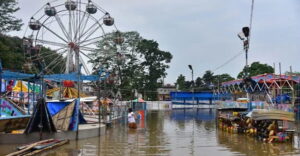
The largest lake within Chengalpattu town, Kolavai Lake (alongside NH 45) features a TTDC-established boat house and serves as a popular weekend relaxation spot for families, as well as a transit point connecting nearby districts to renowned tourist destinations including Mahabalipuram, Muttukadu, and Kanchipuram.
Temples of Chengalpattu District
| Temple | Location | Deity | Key Feature |
| Shore Temple, Mahabalipuram | Mahabalipuram coast | Lord Shiva | UNESCO World Heritage Site; Dravidian architecture; 100-foot relief |
| Kandhaswamy Temple | Thiruporur, ~25 km from Chengalpattu | Lord Murugan | One of 33 designated Murugan temples in Tamil Nadu; Pallava-era |
| Vedagiriswarar Temple | Thirukazhukundram | Lord Shiva | Daily noon eagle-worship phenomenon; 12-year conch ritual |
| Srinivasa Perumal Temple | Semmanjeri, OMR | Lord Vishnu | Eye-healing legend; Prarthana Sthalam for unmarried couples |
| Nithya Kalyana Perumal Temple | Chengalpattu district | Lord Vishnu | 1,000+ years old; blessings for unmarried devotees |
| Sri Sundara Varadharaja Temple | Uthiramerur | Lord Vishnu | Rich cultural and religious heritage |
| Sri Appan Venkatesa Perumal Kovil | Thirumukkudal | Lord Venkatesa | 1,200+ years old; on Palar River banks |
| Sri Gnanapureeswarar Temple | Tiruvadisoolam | Lord Shiva (Idaisuranathar) | One of 276 Padal Petra Sthalams |
Weather in Chengalpattu District
November to February — Best Time: Pleasant weather across both the coastal Mahabalipuram area and the inland districts, ideal for temple visits, beach excursions, and bird-watching at Vedanthangal during peak migratory season (beginning October).
March to June — Summer: Temperatures climb toward 32.6°C, with humid tropical conditions typical of the Coromandel Coast.
July to October — Monsoon: The district receives significant rainfall (average 1,219 mm annually), with winter months recording considerably less precipitation than summer.
Things to Do in Chengalpattu District (2026)
Full-Day Mahabalipuram Heritage Circuit — Explore the Shore Temple, Five Rathas, Arjuna’s Penance, and the nine rock-cut cave temples, allowing a full day for this UNESCO World Heritage Site’s complete experience.
Winter Birdwatching at Vedanthangal — Time a visit for October through February to witness one of India’s oldest and largest water bird sanctuaries at peak migratory activity.
Kandhaswamy Temple Pilgrimage at Thiruporur — Visit one of Tamil Nadu’s 33 designated Murugan temples, combining devotional practice with Pallava-era architectural appreciation.
Eagle-Watching at Vedagiriswarar Temple — Time a noon visit to Thirukazhukundram to witness the famous daily eagle-worship phenomenon atop Vedagiri Hill.
Boating at Mudaliarkuppam and Kolavai Lake — Combine the Raindrop Boat House’s water sports with a relaxed family outing at Chengalpattu’s largest urban lake.
Crocodile Bank Visit — An educational stop near Mahabalipuram, ideal for families and reptile enthusiasts exploring conservation efforts firsthand.
How to Reach Chengalpattu District
By Air: Chennai International Airport (Meenambakkam) is approximately 52-55 km from Mahabalipuram and well connected to all major Indian cities.
By Train: Chengalpattu Junction is a major railway station, with Chengalpet Suburban Station also serving local connectivity; Mahabalipuram’s nearest station is Chengalpattu, approximately 22-23 km away.
By Road: Chengalpattu sits on National Highway 45, 56 km from Chennai, with regular MTC and TNSTC bus services connecting the district to Chennai, Kanchipuram, Vellore, and Tirupati.
Conclusion
Chengalpattu district compresses one of South India’s most celebrated UNESCO World Heritage treasures into a compact, accessible coastal stretch — Mahabalipuram’s 7th-8th century Pallava rock-cut artistry standing alongside one of India’s oldest bird sanctuaries, ancient Murugan and Shiva temples, and a strategic colonial history that shaped the very founding of Madras. For travellers exploring Tamil Nadu’s coastal heritage corridor, Chengalpattu delivers an essential, world-class combination of art, devotion, and natural beauty.
FAQs
Q1. What is Chengalpattu district famous for?
A: Chengalpattu is famous for Mahabalipuram (Mamallapuram), a UNESCO World Heritage Site featuring 7th-8th century Pallava-era rock-cut temples including the Shore Temple, Five Rathas, and Arjuna’s Penance. The district is also known for the Vedanthangal Bird Sanctuary, the ancient Kandhaswamy Murugan Temple at Thiruporur, and its role as the “Gateway of Chennai.”
Q2. When was Chengalpattu district formed?
A: Chengalpattu district was formed on 29 November 2019, when the erstwhile integrated Kanchipuram district was bifurcated, with Chengalpattu town designated as the new district’s headquarters.
Q3. What makes Mahabalipuram a UNESCO World Heritage Site?
A: Mahabalipuram earned UNESCO World Heritage status for its 7th and 8th-century Hindu Group of Monuments, built largely during the reigns of Pallava kings Narasimhavarman I and Narasimhavarman II. These include nine rock-cut cave temples, monolithic rathas (chariot-shaped shrines), the giant open-air rock relief Arjuna’s Penance, and the Shore Temple — together representing some of the finest examples of Dravidian architecture and the transition from rock-cut to structural temple building.
Q4. What is the connection between Chengalpattu and the founding of Madras?
A: In 1639, a local Nayak governor subject to the Vijayanagara kings granted a piece of coastal land within the Chengalpattu region to the British East India Company — the exact site where Fort St George now stands, which became the nucleus of the city of Madras (modern Chennai).
Q5. When is the best time to visit Vedanthangal Bird Sanctuary?
A: The migratory bird approach at Vedanthangal Bird Sanctuary begins at the start of October and continues through the winter months, with November to February offering the most pleasant weather combined with peak bird-watching activity.