Mandya District, Karnataka: Top Attractions, History, Temples, Weather & Things to Do
Between Bengaluru and Mysuru, where the Kaveri spreads across irrigated plains and the air smells permanently of sugarcane, lies Mandya — a district that most people drive through rather than stop in. That is their mistake. Mandya holds one of the finest bird sanctuaries in peninsular India, a dam that transformed Karnataka’s agricultural economy, a Hoysala temple circuit that rivals anything in Hassan, the river island fortress where Tipu Sultan made his last stand, and a Jain pilgrimage hilltop with one of the tallest monolithic statues on earth.
Known locally as Sakkare Nadu — the land of sugar — Mandya was established as a district in 1939 and sits on the fertile Kaveri plain irrigated by the famous Krishna Raja Sagara Dam. Four rivers run through it: the Kaveri, Shimsha, Hemavati, and Lokapavani. The district is only 100 km from Bengaluru and 30 km from Mysuru, which makes it one of the most accessible heritage-and-nature zones in Karnataka.
Mandya District, Karnataka — Quick Overview
| Feature | Details |
| State | Karnataka |
| District Headquarters | Mandya city |
| Also Known As | Sakkare Nadu (Land of Sugar) |
| District Formed | 1939 |
| Area | 4,961 sq km |
| Borders | Mysuru (S), Hassan (W), Tumkuru (N), Ramanagara & Bengaluru Rural (NE), Chamarajanagar (SE) |
| Key Rivers | Kaveri, Shimsha, Hemavati, Lokapavani |
| Famous For | KRS Dam, Brindavan Gardens, Ranganathittu Bird Sanctuary, Srirangapatna, Melukote, Hoysala temples |
| Nearest Airport | Mysuru Airport (MYQ) / Kempegowda International Airport, Bengaluru |
| Railway Station | Mandya Railway Station — Bengaluru–Mysuru main line |
| Best Time to Visit | October to February |
| Summer Temperature | 25°C – 38°C |
| Winter Temperature | 14°C – 28°C |
| Languages Spoken | Kannada (primary) |
| Key Taluks | Mandya, Srirangapatna, Maddur, Nagamangala, Krishnarajpet, Pandavapura, Malavalli |
History of Mandya District
Ancient and Medieval Dynasties
Mandya’s recorded history traces through an extraordinary succession of southern Indian powers. The Ganga dynasty held this fertile Kaveri plain in the early medieval period, followed by the Cholas who left their stamp most visibly at Talakadu on the river. The Hoysalas — Karnataka’s most celebrated temple builders — then took the region and built the cluster of sculptural masterpieces in villages like Kikkeri, Hosaholalu, Basaralu, and Somnathpur (in neighbouring Mysuru) that temple historians still consider among the finest stone work in the country.
The Vijayanagara Empire subsequently held sway, and their influence remains visible at Melukote — a hilltop sacred to the Vaishnava tradition — where a Raya Gopura was begun in the early 16th century by Krishnadevaraya but never completed. The incomplete tower stands today as a monument to ambition interrupted.
Tipu Sultan and the British
The most dramatic chapter of Mandya’s modern history centres on Srirangapatna — the river island fortress on the Kaveri that served as Tipu Sultan’s capital. Tipu and his father Hyder Ali turned the island into one of the most formidable military positions in 18th-century India. The British, under Cornwallis in 1792 and then Wellesley in 1799, twice besieged Srirangapatna. The fall of the fort in May 1799, when Tipu died defending it, ended the Mysore Sultanate and opened southern India to full British administrative control.
The KRS Dam and Modern Mandya
The construction of the Krishna Raja Sagara Dam between 1911 and 1932 — planned by the legendary engineer Sir M. Visvesvaraya under the patronage of Maharaja Krishnaraja Wadiyar IV — transformed Mandya from a rain-fed agricultural region into one of Karnataka’s most productive irrigation districts. Sugarcane followed water. The sugar mills that now define Mandya’s economy grew directly from the assured water supply the dam provided.
Top Attractions in Mandya District
Krishna Raja Sagara Dam (KRS) and Brindavan Gardens
The KRS Dam, built across the Kaveri below its confluence with the Hemavati and Lakshmana Tirtha rivers, was completed in 1932 and named after Maharaja Krishnaraja Wadiyar IV who commissioned it during a famine despite severe state financial strain. It remains one of Karnataka’s most significant engineering monuments — a gravity dam of surki mortar that was the first dam in India to install automated crest gates.
Attached to the dam is the Brindavan Gardens — 60 acres of terraced botanical parkland designed by German botanist Gustav Hermann Krumbiegel and planned by Dewan Sir Mirza Ismail. The garden work began in 1927 and was completed in 1932 alongside the dam. It draws close to 2 million visitors annually, making it one of the most visited gardens in India. Musical fountains, topiary sculptures, pergolas, and boat rides beneath the dam structure make it particularly popular with families. The illuminated fountain show in the evening is the single most crowded part of the experience — arrive early on weekends.
Ranganathittu Bird Sanctuary
Established on 1 July 1940 by the Maharaja of Mysore following a survey by legendary ornithologist Dr. Salim Ali, Ranganathittu Bird Sanctuary sits just 3 km west of Srirangapatna on the Kaveri river. In February 2022, it was designated a Ramsar Wetland of International Importance — the site encompasses 517.7 hectares of riverine wetland including the core sanctuary and surrounding eco-sensitive zone.
The sanctuary comprises six islands and several islets in the Kaveri, hosting over 221 bird species. Breeding season (June–November) turns the islands into extraordinary colonies — Painted Storks, Asian Open-billed Storks, Little Cormorants, Spoonbills, Egrets, and Night Herons nest in noisy, visible profusion. Mugger crocodiles lie on the riverbanks below. Boat rides run visitors through the islands for close-up views. The combination of nesting birds, crocodiles, and river scenery in a 90-minute boat circuit makes Ranganathittu one of the most rewarding wildlife experiences in Karnataka.
Srirangapatna — Tipu Sultan’s Capital
The river island town of Srirangapatna is Mandya district’s deepest historical destination. Situated on an island formed by two channels of the Kaveri, roughly 130 km from Bengaluru, it was Tipu Sultan’s capital and the site of his death in 1799 during the Fourth Anglo-Mysore War.
The Sri Ranganathaswamy Temple, the island’s oldest and most sacred site, is dedicated to Lord Ranganatha (Vishnu in his reclining form) and predates Tipu by centuries. The Lal Mahal (Dariya Daulat Bagh) — Tipu’s summer palace — is one of the finest examples of Indo-Saracenic architecture in the south, its walls painted with scenes from the Battle of Pollilur. The Gumbaz, Tipu Sultan’s mausoleum, where he is buried alongside his father Hyder Ali and mother Fakhr-un-nissa, sits in a well-maintained garden and remains one of the most visited Islamic heritage sites in Karnataka. The town also contains Tipu’s mosque (built reportedly over a demolished Hanuman temple), the underground dungeons of Colonel Bailey’s Cell, and extensive fort walls still walkable along the riverbank.
Melukote (Melkote) — Cheluvanarayana Swamy Temple
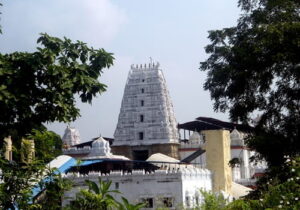
Perched on a granite hill 51 km from Mandya city, Melukote is one of the most important Vaishnava pilgrimage sites in Karnataka. The Sri Cheluvanarayana Swamy Temple here is ancient — the presiding deity is believed to have been recovered by the philosopher-saint Ramanuja from the court of a northern king, and the legend of that recovery is re-enacted annually during the Vairamudi Festival, when the deity is adorned with a diamond crown said to have been gifted by the same king.
The Vairamudi Utsava draws approximately 200,000 visitors and is one of the largest religious festivals in Karnataka. On the hilltop above the main temple, the Yoga Narasimha temple sits in serene isolation with sweeping views of the surrounding countryside. The incomplete Raya Gopura begun by Krishnadevaraya in the early 16th century stands at the base — its unfinished silhouette framing the hill approach in a way that finished architecture rarely achieves.
Shivanasamudram Falls (Gaganachukki and Barachukki)
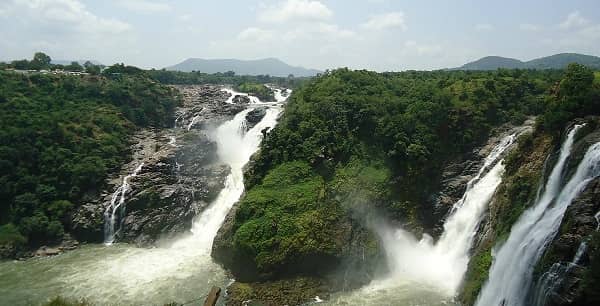
Where the Kaveri River drops off the Deccan Plateau, it splits around a rocky island and plunges in twin cascades — Gaganachukki on one side in Malavalli taluk, Barachukki on the other in Kollegala. Gaganachukki falls from a height of approximately 90 metres; Barachukki from around 69 metres. Together they form one of the most dramatic waterfall systems in South India.
The falls are at their most spectacular during and immediately after the monsoon (July–October), when the full volume of the Kaveri comes over the edge in a roar that can be heard from a considerable distance. The approach road is surrounded by teak plantations and the Cauvery Wildlife Sanctuary. India’s first hydroelectric power plant was installed at Shivanasamudram in 1902 — the power station, still partially operational, adds an industrial heritage layer to the natural drama.
Hoysala Temple Circuit — Kikkeri, Hosaholalu, Basaralu, Nagamangala
Mandya district contains a remarkable cluster of Hoysala-era temples that receive a fraction of the attention given to the famous sites at Belur and Halebidu in Hassan. All were built between the 11th and 13th centuries CE and share the characteristic Hoysala qualities — star-shaped plans, incredibly dense sculptural friezes, and the distinctive black chloritic schist stone that takes a polish like metal.
The Brahmeshwara Temple at Kikkeri (12th century, located next to a large tank) is dedicated to Lord Shiva despite its Vaishnava exterior friezes — an unusual feature. The Lakshminarayana Temple at Hosaholalu is a Trikuta (three-shrined) temple of the 13th century, declared a monument of national importance by the Archaeological Survey of India. The Mallikarjuna Temple at Basaralu, a small village near Nagamangala, is another outstanding Hoysala composition. These three together make a circuit of about 60–80 km, and they are rarely crowded — which is the best reason to do them.
Kokrebellur Bird Village
About 40 km from Mandya city, the village of Kokrebellur has an extraordinary relationship with Spot-billed Pelicans and Painted Storks. The birds nest within the village itself — in trees overhanging houses and courtyards — and the villagers have traditionally protected them as sacred. The coexistence of nesting colonies of large waterbirds with human habitation in active use is genuinely unusual in India and in the world. The best viewing season is November to March. The experience of walking through a village where Pelicans roost on rooftops ten feet above you belongs to no other place in Karnataka.
Temples of Mandya District
| Temple | Location | Deity | Key Feature |
| Sri Ranganathaswamy Temple | Srirangapatna | Lord Ranganatha (Vishnu) | Active pilgrimage temple on Kaveri island; predates Tipu Sultan |
| Cheluvanarayana Swamy Temple | Melukote | Lord Cheluvanarayana (Vishnu) | Major Vaishnava Divya Desam; Vairamudi Utsava draws ~200,000 visitors |
| Yoga Narasimha Temple | Melukote hilltop | Lord Narasimha | Hilltop shrine; panoramic views of surrounding plains |
| Brahmeshwara Temple | Kikkeri | Lord Shiva | 12th-century Hoysala; beside a large tank; unusual Shaiva-Vaishnava mix |
| Lakshminarayana Temple | Hosaholalu | Lord Vishnu (Lakshminarayana) | 13th-century Hoysala Trikuta temple; ASI monument of national importance |
| Mallikarjuna Temple | Basaralu, Nagamangala | Lord Shiva | Classic Hoysala composition; rarely visited; outstanding friezes |
| Nimishamba Temple | Ganjam, Kaveri bank | Goddess Nimishamba | Puranic legend attached; north bank of Kaveri at Ganjam |
| Karighatta Temple | Karighatta hills | Lord Shiva | Scenic hilltop temple on the Lokapavani river banks |
| Saumya Keshava Temple | Nagamangala | Lord Vishnu | 12th-century Hoysala; declared monument of national importance by ASI |
Weather in Mandya District — Season by Season
Mandya has a semi-arid tropical climate moderated by its elevation on the Deccan plateau. The Kaveri river system and its reservoir significantly influence local humidity and temperature compared to the drier north Karnataka districts.
October to February — Best Time to Visit
This is the ideal window across the board. October and November bring post-monsoon freshness — Ranganathittu is alive with birds, the Kaveri is full and clear, and the falls at Shivanasamudram are in excellent flow. December and January are cool, occasionally misty in the mornings, and perfect for temple circuit days — comfortable all day rather than just in the mornings and evenings. February maintains pleasant warmth. The Vairamudi Utsava at Melukote typically falls in March–April — check dates annually as it varies.
June to September — Monsoon
Southwest monsoon arrives in June and transforms the district. Shivanasamudram falls are at full spectacle — the volume is highest in August and September. The Hoysala temple villages become intensely green. Ranganathittu’s bird colonies are actively nesting and at maximum population. Travel within the district on minor roads can be disrupted by flooding, particularly in the Kaveri floodplain around Srirangapatna.
March to May — Summer
Temperatures climb from 30°C in March to 38°C by May. The falls reduce significantly after February as the Kaveri drops. Temple visits are best confined to mornings and late afternoons. This is the least recommended season for extended sightseeing.
Things to Do in Mandya District (2026)
Take the Boat at Ranganathittu — Book the morning slot if possible. The breeding colonies on the islands are most active and visible before 10 AM. The combination of nesting Painted Storks, basking crocodiles, and the Kaveri river mist makes this one of Karnataka’s finest wildlife experiences within an hour of Mysuru.
Do the Full Srirangapatna Heritage Circuit — Walk the Ranganathaswamy Temple, Dariya Daulat Bagh, Gumbaz, Colonel Bailey’s Dungeon, and the fort walls in a single day. Hire a local guide from the temple area — the historical connections between the sites are complex enough to require context.
Drive the Hoysala Temple Circuit — Base yourself in Mandya city and plan Kikkeri, Hosaholalu, and Basaralu in one long day. These temples are in villages rather than tourist towns. Arrive, take your time with the carvings, and leave. The lack of crowds is itself a gift.
Attend Vairamudi Utsava at Melukote — If your 2026 travel dates fall in the right window (typically March–April), this is one of the most extraordinary devotional events in southern Karnataka. The procession of the bejewelled deity draws 200,000 people, yet the hilltop temple circuit above the main shrine remains accessible for those willing to climb.
Watch the Evening Musical Fountain at Brindavan Gardens — Arrive by 5 PM to walk the gardens in the light, then stay for the illuminated fountain show. Weekdays are dramatically less crowded than weekends and holidays.
Walk the Kokrebellur Village — A guided walk through the Pelican-and-Stork village between November and March is one of the most unusual nature experiences in Karnataka. Bring a telephoto lens.
Visit Shivanasamudram Post-Monsoon — October and November offer the best combination of full water and accessible approach roads. The viewpoints on both sides require some walking — wear appropriate footwear.
How to Reach Mandya District
By Air: Mysuru Airport (MYQ) is the nearest airport, handling limited domestic services. Kempegowda International Airport, Bengaluru, approximately 100 km away, is the practical international and major domestic gateway.
By Train: Mandya Railway Station sits on the Bengaluru–Mysuru main line. Multiple express and passenger trains connect daily. Journey time from Bengaluru City is approximately 1.5 to 2 hours. Srirangapatna also has its own station on the same line.
By Road: NH 48 (Bengaluru–Mysuru highway) and NH 209 pass through the district. KSRTC buses run frequent services between Bengaluru, Mandya, and Mysuru. The Mandya–Mysuru stretch is approximately 30 km; Bengaluru to Mandya is approximately 100 km.
Practical Tips for Visitors (2026)
- Ranganathittu boat rides operate from 6 AM to 6 PM; early morning slots for the best bird activity.
- Brindavan Gardens closes at 8 PM; the musical fountain show begins after dark — verify current show timings.
- The Hoysala temples at Kikkeri and Hosaholalu have no permanent priests on some days — call ahead if you want the inner sanctum opened.
- Srirangapatna is best explored on foot or by hired bicycle from the bus stand.
- At Shivanasamudram, the Gaganachukki viewpoint on the Mandya side and Barachukki on the other side require separate approach roads — plan both if doing a full day.
- Mandya’s sugarcane jaggery and coconut-based sweets are worth picking up at the local bazaar.
Conclusion
Mandya is one of Karnataka’s genuinely underrated districts, routinely bypassed by travellers moving between Bengaluru and Mysuru on the highway. The KRS Dam and Brindavan Gardens are famous enough; the Ranganathittu Bird Sanctuary and Srirangapatna get reasonable attention. But the Hoysala temple circuit in Kikkeri, Hosaholalu, and Basaralu, the Melukote hill pilgrimage, the Pelican village at Kokrebellur, and the twin falls at Shivanasamudram represent a quality of heritage and nature experience that could hold a traveller for three to four days without repetition. For anyone building a Karnataka heritage circuit in 2026, Mandya belongs squarely in the itinerary.
FAQs About Mandya District, Karnataka
Q: What is Mandya famous for?
A: Mandya is famous for the KRS Dam and Brindavan Gardens, the Ranganathittu Bird Sanctuary (a Ramsar Wetland), Srirangapatna — Tipu Sultan’s capital and final battlefield, the Melukote Vaishnava pilgrimage hilltop, the Shivanasamudram twin waterfalls, and a rich circuit of 12th–13th century Hoysala temples.
Q: How far is Mandya from Bengaluru?
A: Mandya city is approximately 100 km from central Bengaluru via NH 48. The drive typically takes 1.5 to 2 hours. The train journey on the Bengaluru–Mysuru line takes approximately 1.5 hours.
Q: What is the best time to visit Mandya?
A: October to February is ideal. The bird sanctuary is most active, the weather is comfortable for outdoor sightseeing, and the post-monsoon Kaveri river is full without being dangerous. For the Vairamudi Festival at Melukote, plan for March–April (verify exact dates annually).
Q: Is Ranganathittu worth visiting?
A: Absolutely, especially between June and November when the breeding colonies are in full activity. It is one of the finest riverside bird sanctuaries in India, designated a Ramsar Wetland in 2022. The boat ride through the island colonies is the highlight.
Q: Can Mandya be covered as a day trip from Bengaluru?
A: A day trip covers the KRS Dam, Brindavan Gardens, Ranganathittu, and Srirangapatna comfortably. Two days allow the addition of Melukote, the Hoysala temple circuit, and Shivanasamudram. Three days give enough time to do everything without rushing.