Villupuram District, Tamil Nadu: Top Attractions, History, Temples, Weather & Things to Do
There is a version of Tamil Nadu that most tourists never reach. They stop at Mahabalipuram, cut across to Pondicherry, maybe visit Chidambaram on the way south — and Villupuram becomes just a railway junction they passed through. That’s their loss.
Villupuram district sits in the middle of Tamil Nadu’s Coromandel heartland, roughly 160 km south of Chennai, and it quietly holds one of the most extraordinary fort complexes in all of South India, a cluster of Divya Desam and Paadal Petra temples that predate most medieval dynasties, a UNESCO World Heritage Site declared in 2025, a Jain cave shelter carved into rock in the 9th century, and a coastline that most beach guides haven’t bothered to write about. The district was carved out of the old South Arcot composite district in 1993 and remains, in the best possible way, under the radar.
Villupuram District, Tamil Nadu — Quick Overview
|
Feature |
Details |
|
State |
Tamil Nadu |
|
District Headquarters |
Villupuram town |
|
District Formation |
30 September 1993 (bifurcated from South Arcot District) |
|
Area |
Second largest district in Tamil Nadu |
|
Location |
~160 km south of Chennai, on NH 45 |
|
Borders |
Cuddalore (N), Kallakurichi (W), Salem (NW), Thiruvannamalai (W), Puducherry (E), Bay of Bengal (E) |
|
Famous For |
Gingee Fort (UNESCO 2025), ancient temples, Auroville, Marakkanam coast |
|
Key Taluks |
Villupuram, Gingee, Tindivanam, Thirukoilur, Vanur, Ulundurpet, Vikravandi |
|
Nearest Airport |
Chennai International Airport (~160 km) / Puducherry Airport (~60 km) |
|
Nearest Major Railway Junction |
Villupuram Junction (major Southern Railway junction) |
|
Best Time to Visit |
November to February |
|
Summer Temperature |
33°C – 42°C |
|
Winter Temperature |
20°C – 30°C |
|
Languages Spoken |
Tamil (primary), Telugu, some French influence near Auroville |
A Brief History of Villupuram District
Villupuram’s story is essentially the story of South Arcot — a region that changed hands so many times across fifteen centuries that its landscape became layered with the ambitions of dynasties that rarely agreed on anything except that the territory was worth controlling.
The earliest recorded presence belongs to the Cholas, who built temples, administered the plains, and left inscriptions that still surface in temple walls today. The Pallavas, whose rock-cut architecture defines so much of early Tamil Nadu, also held influence here before the great medieval Chola revival swept south. The Pandyas came next, and then a decisive turning point: in 1378, the Vijayanagara Kingdom moved in and held sway over the region, fundamentally shaping the fort architecture and temple patronage that visitors encounter today.
Gingee — or Senji — became the fulcrum of Villupuram’s historical drama. The small Chola fort on its hills was dramatically expanded under the Vijayanagara rulers and later became the headquarters of the Maratha king Shivaji in 1677. The Mughals under Aurangzeb — who reportedly called Gingee one of the most difficult forts to conquer in South India — eventually took it in 1698. Then came the British and the French, who turned the district into a military battleground as they fought for control of the Coromandel coast throughout the 18th century.
Post-independence, the district retained its heritage infrastructure and its role as a major railway junction. In July 2025, Gingee Fort was officially inscribed on the UNESCO World Heritage List as part of the Maratha Military Landscapes of India — a recognition that finally gave this long-overlooked fort the international standing it has always deserved.
Top Attractions in Villupuram District
Gingee Fort (Senji Fort) — The Troy of the East
If you only visit one place in Villupuram, make it Gingee. The British called it the “Troy of the East.” Shivaji called it the most impregnable fortress in India. Aurangzeb, who had to besiege it for years before it fell, likely had stronger words. In July 2025, UNESCO declared it a World Heritage Site as part of the Maratha Military Landscapes of India.
The fort doesn’t occupy a single hill — it spans three: Rajagiri, Krishnagiri, and Chandrayandurg. Massive granite and laterite walls, over 60 feet high in sections, link the three citadels and extend for around 13 km, enclosing an area of approximately 7 square kilometres. Inside, there are granaries, prison cells, ancient wells, temple ponds, barracks, and a moat that once stretched 24 metres wide. The whole complex functions less like a fort and more like a self-contained fortified city.
The Rajagiri citadel is the highest point, rising to roughly 800 feet, and requires a climb of around 800 steps. The views from the top — rocky hills, green farmland, and the town of Gingee spread below — make the effort worth it. Rajagiri also houses the Kamalakanni Amman Temple and the Elephant Tank, a water reservoir built to sustain soldiers and elephants during sieges.
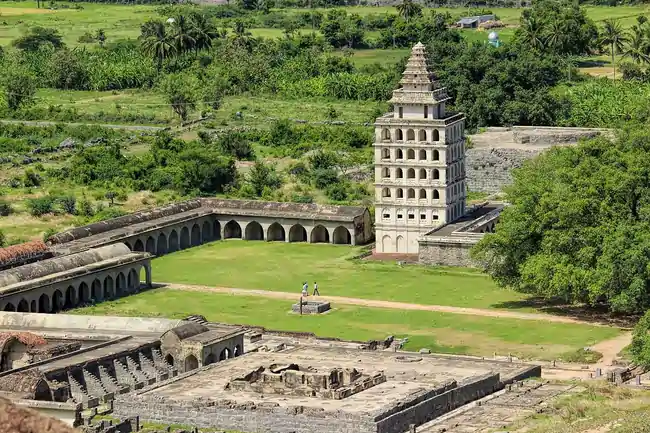
The Kalyana Mahal within the fort complex is one of its most architectural distinctive structures — a seven-storeyed marriage hall built in a style that fuses Indo-Islamic and Dravidian design, with a square central courtyard, surrounding rooms that once housed the royal household’s women, and a 27-metre pyramidal tower at its centre. The tower’s stonework closely resembles Vijayanagara Nayaka architecture from the same period.
Also within the fort, the Venugopalaswamy Temple contains an exceptionally fine sculpture of Lord Krishna playing the flute flanked by his two consorts — one of the most beautiful pieces of medieval Tamil sculpture that most visitors to the state never see, simply because it is embedded inside a fort rather than in a temple town.
The fort is open daily from 9 AM to 4:30 PM. Entry fees are nominal. The best time to visit is between November and February — climbing in April or May is genuinely punishing.
Auroville — The International Township
Located just across the Puducherry border but firmly within the Villupuram district’s sphere, Auroville is one of India’s most unusual social experiments. Founded in 1968 at the behest of the Mother of the Sri Aurobindo Ashram, it was launched at a ceremony attended by representatives of 124 nations and endorsed by UNESCO. The vision was — and remains — a universal township dedicated to human unity, sustainable living, and spiritual growth beyond nationality and religion.
The Matrimandir, Auroville’s central structure, is a golden spherical building designed for silent concentration and meditation. Nearly 2,000 residents from around 40 countries now live across 100 or more scattered settlements in and around the township. Entry to the Matrimandir requires advance booking and involves a walk through impressive reforested land. It is not a tourist attraction in any conventional sense — there is no performance, no guided show. What it offers is silence, greenery, and an atmosphere of genuine intentionality that is genuinely rare.
Note for 2026 visitors: booking the Matrimandir slot requires advance email registration and has limited capacity. Seniors, children, and those with mobility challenges will find the walk difficult in the heat.
Mailam Arulmigu Subramaniya Swami Temple
On a small rocky hillock about 32 km from Villupuram on the Puducherry–Tindivanam road, this Murugan temple is one of the more significant pilgrimage sites in the district. The hillock is modest in scale, but the views from the top are wide and uninterrupted — farmland in every direction, the kind of Tamil Nadu landscape that looks exactly as it should.
The Panguni Uthiram festival, held in March–April, transforms Mailam from a quiet local pilgrimage stop into a destination that draws thousands of devotees from across Tamil Nadu. If you visit during the festival, arrive early. If you visit outside it, the relative calm makes for a contemplative experience.
Thirukoilur — Ulagalantha Perumal Temple (Divya Desam)
About 40 km west of Villupuram on the banks of the South Pennar (Thenpennai) river, Thirukoilur is home to one of Tamil Nadu’s most significant Vishnu temples. The Ulagalantha Perumal Temple — also known as the Trivikrama Temple — is one of the 108 Divya Desams, the sacred Vishnu shrines celebrated in the Nalayira Divya Prabandham composed by the Alvar saints between the 7th and 9th centuries.
The presiding deity is Ulagalantha Perumal (Trivikrama) — Vishnu in his cosmic form of measuring the three worlds in three strides. The main idol, believed to be made of Tharu wood, shows the deity with his right leg raised, ready to take the third step — an image that carries extraordinary iconographic force once you understand the Vamana-Trivikrama legend behind it.
The temple’s 11-tiered Rajagopuram stands 192 feet tall — the third tallest temple tower in Tamil Nadu after Srirangam and Srivilliputhur. The original brick temple is believed to have been built by Medieval Cholas and replaced with stone under Virarajendra Chola (1063–70 CE). Inscriptions from Chola, Pandya, Pallava, and Vijayanagara kings survive within the complex, making it a living archive of South Indian royal patronage.
The temple is said to be the place where the three Mudhal Alwars — Poigai, Bhootham, and Pey — received the darshan of Lord Vishnu and composed the earliest hymns that would eventually become the Nalayira Divya Prabandham. That literary-spiritual significance gives this temple a depth beyond its architecture. Temple timings are generally 6:30 AM to 12 PM and 4 PM to 8 PM; verify locally before visiting.
Thiyagadurgam — Jain Cave Temples
A short drive from Gingee town leads to a rocky hillock containing two Jain caverns — one of the genuinely undervisited archaeological sites in Villupuram district. A large boulder near the site carries sculptural reliefs of all 24 Tirthankaras carved in the 9th-century style. The level of craftsmanship in these reliefs, combined with the near-total absence of crowds, makes Thiyagadurgam one of those places that rewards the traveller willing to venture beyond the main fort circuit.
Marakkanam — The Bay of Bengal Coastline
On the eastern edge of the district, where land meets the Bay of Bengal, Marakkanam is a coastal town that most travel guides have under-described. The beach here is undeveloped by Tamil Nadu standards — no promenade, no commercial strip — and the landscape has a raw, working quality: salt pans, casuarina trees leaning in the sea wind, fishing boats hauled up on the sand. The salt pans are particularly striking in the early morning when the light turns the shallow water into something between silver and pink.
Marakkanam is not a beach resort destination. It is a place to see the Bay of Bengal without the infrastructure that usually comes between a visitor and the coast.
Veedur Dam and Sathanur Dam
Villupuram district has two significant dams worth a visit for those who enjoy reservoir landscapes and scenic drives. Veedur Dam on the Manimuktar river and Sathanur Dam on the Thenpennai river (near Tiruvannamalai border) both offer scenic surrounds and moderate visitor infrastructure. Sathanur also has a crocodile park and a small garden complex, making it more family-friendly. Both are best visited between November and January when water levels are high after the northeast monsoon.
Singavaram Rock Temple
Near Gingee, perched on a hill, this rock-cut cave temple is dedicated to Lord Ranganatha (Vishnu in his reclining form). The presiding idol — a 24-foot reclining Ranganatha carved from a single rock — is the temple’s defining feature and its sculptural pride. The cave temple was historically the royal deity shrine of the Gingee rulers, and it commands panoramic views of the surrounding terrain that make the climb worthwhile even for visitors who are not particularly interested in the iconography.
Temples of Villupuram District
The district is one of Tamil Nadu’s most temple-dense regions. Here is a consolidated reference:
|
Temple |
Location |
Deity |
Key Feature |
|
Ulagalantha Perumal Temple |
Thirukoilur |
Lord Vishnu (Trivikrama) |
108 Divya Desam; 192 ft Rajagopuram (3rd tallest in TN); Tharu wood idol |
|
Venugopalaswamy Temple |
Inside Gingee Fort |
Lord Krishna |
Exquisite sculpture of Krishna with consorts; inside fort citadel |
|
Singavaram Rock Temple |
Near Gingee |
Lord Ranganatha |
24-ft reclining Vishnu carved from single rock; royal shrine of Gingee kings |
|
Mailam Murugan Temple |
Mailam, 32 km from Villupuram |
Lord Murugan (Subramaniya) |
Hillock temple; famous Panguni Uthiram festival |
|
Thiruvamathur Chola Temple |
Thiruvamathur |
Lord Shiva |
Ancient Chola-era temple; centuries-old mural paintings and inscriptions |
|
Panangatteswarar Temple |
Panayapuram |
Lord Shiva |
One of 276 Paadal Petra Sthalams; built by Kulothunga Cholan |
|
Vakrakaali Amman & Chandramouleeswar Temple |
Thiruvennainalur |
Shiva & Goddess Vakrakaali |
Sung by Thirugnana Sambandar; full moon night special prayers |
|
Lakshmi Narasimhar Temple |
Poovarasankuppam |
Lord Narasimha |
Built by Narasimha Pallavar I in 7th century |
|
Arulmigu Chandramoulisvarar Temple |
Thiruvennainalur |
Lord Shiva |
Built by the famous Chola queen Sembiyan Madheviyar |
|
Jain Cave Temples |
Thiyagadurgam, near Gingee |
24 Tirthankaras |
9th-century rock-cut Jain sculptures; rarely visited |
Weather in Villupuram — Season by Season
Villupuram sits on the Coromandel coast with a tropical climate influenced by its proximity to the Bay of Bengal. Unlike interior Tamil Nadu which depends mainly on the southwest monsoon, Villupuram receives significant rainfall from the northeast monsoon (October–December) — a pattern that shapes its entire seasonal rhythm.
November to February — Best Time to Visit
This is the most comfortable window and the ideal time to plan any serious sightseeing. Temperatures settle between 20°C and 30°C, mornings are genuinely pleasant, and the northeast monsoon has typically done its work by mid-November, leaving the landscape green and the fort trails accessible. The Gingee Fort climb is manageable, temple festivals are in full swing, and the coastal areas are at their most picturesque.
June to September — Southwest Monsoon
The district receives moderate rainfall from the southwest monsoon, with temperatures hovering between 32°C and 34°C. The landscape greens up considerably. This is not the peak tourist season, but the Gingee Fort complex and the dam areas are genuinely atmospheric with light cloud cover. Avoid the fort climb on rainy days — the granite steps become slippery.
October to December — Northeast Monsoon
Villupuram’s primary rainfall season. The northeast monsoon brings substantial rain to the Coromandel coast between October and December, with September averaging around 115 mm and October–November being the wettest months. The dams fill up, rivers run, and the countryside looks its greenest. Fort trekking is best avoided in heavy rain but the temple circuit is fine.
March to May — Summer
Hot and increasingly harsh as the season progresses. Daytime temperatures regularly reach 38°C–42°C. The Gingee Fort climb in peak summer is exhausting and genuinely inadvisable for older visitors or children. If you must visit in summer, confine outdoor activities to before 8 AM and after 4 PM.
Things to Do in Villupuram District (2026)
Climb Gingee Fort and the Rajagiri Citadel — Begin early, carry water, and give yourself at least half a day. Rajagiri requires around 800 steps and is not suitable for everyone, but the Kalyana Mahal and the lower fort structures are accessible even for those who skip the summit climb.
Visit the UNESCO Heritage Site — Since Gingee Fort’s inscription on the UNESCO World Heritage List in July 2025 as part of the Maratha Military Landscapes of India, the Archaeological Survey of India has been managing the site more actively. Check current entry fees and timings before visiting, as these are subject to revision following the heritage designation.
Do the Temple Circuit — Villupuram to Thirukoilur (Ulagalantha Perumal), then to Mailam (Murugan), and back via Thiruvamathur makes for a full day of temple exploration without feeling rushed.
Explore Auroville — Book the Matrimandir slot in advance by email. The community areas, organic farms, and visitor centre can be explored more freely. Go on a weekday to avoid the Pondicherry day-tripper crowd.
Drive to Marakkanam for the Coast — An underused day-trip route from Villupuram. The drive through flat Tamil Nadu countryside to the salt-pan coastline is itself an experience. The beach is unmanicured and better for it.
Discover the Jain Caves at Thiyagadurgam — Plan this as an add-on to the Gingee Fort visit since both are in the same area. A local guide from Gingee town can point you directly to the site.
Visit Singavaram Rock Temple — The 24-foot reclining Vishnu carved from solid rock is sculptural work of serious quality. The temple is rarely crowded and the hilltop views towards the fort make it a natural pairing with the Gingee circuit.
Festival Travel — Panguni Uthiram at Mailam — If your travel dates fall in March–April, the Mailam Murugan Temple festival draws thousands of devotees and is one of the more vivid expressions of Tamil devotional culture in this part of the state.
How to Reach Villupuram
By Air: The nearest major airport is Chennai International Airport, approximately 160 km away. Puducherry Airport, roughly 60 km from Villupuram, handles limited domestic services — check current operating status before planning.
By Train: Villupuram Junction is a major Southern Railway hub. Trains connect to Chennai, Bengaluru, Trichy, Madurai, Tirupati, and virtually every corner of Tamil Nadu. It is also the junction point for the Pondicherry branch line. Multiple daily trains serve all major routes.
By Road: Villupuram lies on NH 45 (Chennai–Theni) and NH 234 (Villupuram–Mangalore via Thiruvannamalai–Vellore). State and private buses connect the town to Chennai, Pondicherry, Thiruvannamalai, and Cuddalore frequently. Gingee is about 40 km from Villupuram town by road.
Practical Tips for Visitors (2026)
- Start Gingee Fort early. The gate opens at 9 AM. By 11 AM in any season, the exposed rock paths heat up fast.
- Carry water and snacks inside the fort. There are no food stalls or restaurants within the fort complex.
- Auroville Matrimandir booking is non-negotiable. Walk-ins are not permitted. Book via email weeks in advance, especially during December–January.
- For temple visits — dress conservatively. Many of Villupuram’s Agamic temples have strict dress codes; men in lungis or dhotis are welcomed; shorts are not.
- Thirukoilur timings: The Ulagalantha Perumal Temple closes between 12 PM and 4 PM. Plan your visit accordingly.
- · Carry cash. Rural temple towns and the Gingee area operate largely on cash. ATMs exist in Gingee and Villupuram town but not always near the fort or smaller temples.
- Hiring a local guide at Gingee is genuinely worth the cost. The fort’s internal complexity — multiple citadels, hidden temples, water systems — benefits enormously from someone who knows the terrain.
Conclusion
Villupuram doesn’t announce itself. The town is a working administrative and railway hub — practical, not picturesque — and first-time visitors who stay only in the town itself might wonder what the fuss is about. But step forty kilometres west to Gingee, or forty kilometres east to Thirukoilur, or follow the road south toward Mailam and the coast, and the district reveals what it actually holds: a UNESCO fort complex that deserves to be in the same breath as Golconda or Chittorgarh, Divya Desam temples of extraordinary antiquity, a Jain cave archive that most of Tamil Nadu has forgotten, and a coastline that tourism hasn’t arrived at yet.
In 2026, with the UNESCO listing having finally put Gingee on the map, visitor numbers will grow. Go soon, especially to the smaller sites — the Jain caves at Thiyagadurgam, the Singavaram rock temple, the salt-pan coast at Marakkanam — before the infrastructure catches up and the crowds arrive.
FAQs About Villupuram District, Tamil Nadu
1. What is Villupuram famous for?
Villupuram is primarily famous for Gingee Fort (also called Senji Fort), one of the most formidable fort complexes in South India, now a UNESCO World Heritage Site (inscribed July 2025). The district is also significant for its ancient Chola and Vijayanagara-era temples, the Ulagalantha Perumal Divya Desam temple at Thirukoilur, and its proximity to Auroville.
2. How far is Villupuram from Chennai?
Villupuram is approximately 160 km south of Chennai. By train from Chennai Central or Chennai Egmore, the journey takes roughly 2.5 to 3 hours depending on the service. By road via NH 45, expect around 3 hours under normal traffic conditions.
3. What is the best time to visit Villupuram?
November to February is the best time. The weather is at its most comfortable — temperatures between 20°C and 30°C — and the post-monsoon landscape is green. It is also the best period for the Gingee Fort climb and outdoor temple visits. Avoid peak summer (April–May) when temperatures regularly exceed 40°C.
4. Is Gingee Fort a UNESCO World Heritage Site?
Yes. Gingee Fort was inscribed on the UNESCO World Heritage List in July 2025, as part of the Maratha Military Landscapes of India — recognising its extraordinary military architecture and historical significance across multiple dynasties including the Cholas, Vijayanagara rulers, Marathas, Mughals, French, and British.
5. How many days are enough to explore Villupuram district?
Two to three days is a comfortable itinerary. Day one for Gingee Fort, Kalyana Mahal, and Singavaram temple. Day two for the Thirukoilur Divya Desam temple and Mailam Murugan temple. Day three for Auroville and the Marakkanam coastline. Travellers with a specific interest in fort history or temple architecture may want to extend to four days.