Malda District, West Bengal: Top Attractions, History, Temples, Weather & Things to Do
Twelve kilometres south of English Bazar, where the road pushes through thick mango orchards toward the Bangladesh border, the land quietly transforms. The trees thin, the ground rises slightly, and suddenly — between the groves and the low scrub — a 21-metre gateway of red brick and terracotta emerges from the vegetation. The Dakhil Darwaza. Built in 1425 AD. Crowned with five-storey towers at each corner. So intact that you instinctively look for the city it was meant to introduce.
The city — Gaur, medieval Bengal’s most storied capital — lies around it in ruins. What remains is extraordinary: mosques, gateways, a minar, fortification walls, the ghost of a palace, all distributed across a landscape bisected by the Indo-Bangladesh border. Gaur alone would justify a trip to Malda. But the district also holds the ruins of Pandua — another medieval capital with the third-largest concentration of Muslim monuments in Bengal — a museum full of Pala-era sculpture, silk weavers working hundred-year-old looms, mango orchards that produce one of the world’s most celebrated mango varieties, and a folk performance tradition called Gambhira that UNESCO observers have written about with genuine admiration.
Malda District, West Bengal — Quick Overview
| Feature | Details |
| State | West Bengal |
| District Headquarters | English Bazar (also called Malda) |
| Former Name | English Bazaar — named after the English factory established here in 1771 |
| Area | 3,733 sq km |
| Location | ~347 km north of Kolkata; ~256 km south of Siliguri |
| Borders | Bangladesh (E & S), Murshidabad (S), Birbhum (SW), West Dinajpur (N & W) |
| Famous For | Gaur & Pandua ruins, Fazli mango, Tussar silk, Gambhira folk tradition |
| Key Rivers | Mahananda, Kalindi (Ganga tributary system) |
| Nearest Airport | Bagdogra Airport (IXB), West Bengal — ~230 km |
| Railway Station | Malda Town (railway divisional headquarters, Eastern Railways) |
| Best Time to Visit | October to March |
| Summer Temperature | 28°C – 42°C |
| Winter Temperature | 8°C – 22°C |
| Languages Spoken | Bengali (primary), Hindi, Santhali |
| Key Subdivisions | Malda Sadar (English Bazar, Old Malda), Chanchal |
History of Malda District
Ancient Origins — Pundravardhana, Palas, and Senas
Malda’s ancient identity is tied to the name Gaur — or Gourpura — a city that the grammarian Panini mentioned in antiquity and that grew into one of medieval India’s most powerful capitals. The ancient district formed part of Pundravardhana, an early historical region that covered much of northern Bengal and Bihar. The Buddhist Pala dynasty held the region from the 8th century CE, patronising art and learning at a scale whose remnants now fill the Malda Museum. The Hindu Sena kings succeeded them, and after 1204 CE, when Bakhtiyar Khilji’s forces swept through Bengal, the region came under Islamic rule — the beginning of a succession of Muslim dynasties that built Gaur into a capital of genuine imperial scale.
Gaur — Capital of Three Dynasties
Gaur served as the capital of the Bengal Sultanate through multiple dynasties — the Ilyas Shahis, the Hussain Shahis, and briefly the Habshi sultans who left their own architectural mark. At its height in the 14th and 15th centuries, Gaur was among the most significant cities in Asia — a centre of Islamic scholarship, textile trade, and architectural ambition. The Mughal emperor Humayun captured it and renamed it Jannatabad. Repeated epidemics and the collapse of the river navigation system that fed the city ultimately emptied it. Today, the ruins sit on the Indo-Bangladesh border — some monuments in India, others across the frontier in Bangladesh.
British Period — The English Factory and the Name
In 1771, the British East India Company established a factory at the settlement that would become English Bazaar — a name that stuck long enough to become the district’s formal headquarters designation. The district of Malda was formally constituted in 1813. Through the 18th and 19th centuries, it was a centre of prosperous cotton and silk industries, which explains the Tussar silk tradition that still thrives in the district today. The partition of 1947 placed Malda in West Bengal, and the district celebrates its independence on August 17 — the date the partition boundary was confirmed for this specific area.
Top Attractions in Malda District
Gaur (Gour) — The Ruined Capital
Gaur, 12 km south of English Bazar right on the Indo-Bangladesh border, is one of the great archaeological sites of eastern India — and one of the most undervisited given its actual importance. It was the capital of medieval Bengal through several successive dynasties from the 13th to the 16th century, and the ruins distributed across its landscape tell that entire story in brick, terracotta, and stone.
Dakhil Darwaza (1425 AD)
The Dakhil Darwaza is the best-preserved and most visually dramatic structure in Gaur. Built in 1425 AD during the Ilyas Shahi dynasty, it served as the main ceremonial gateway to the fort complex. Standing 21 metres high and 34.5 metres wide, built of small red bricks with terracotta decoration, its four corners are topped with five-storey towers. Cannons were fired from the gateway during royal ceremonies — which is why it was also called Salami Darwaza (Salute Gate). In the south-east corner of the fort, a 20-metre-high wall encloses the ruins of what was once a royal palace.
Bara Sona Mosque (Great Golden Mosque)
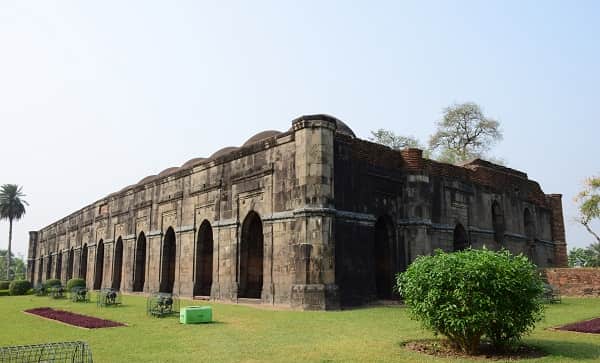
Also called Boro Shona Masjid or Baroduari Mosque (the twelve-gated mosque), the Bara Sona Mosque is a masterpiece of 15th-century Islamic architecture in Bengal. Its scale and the quality of its original tilework — now largely lost — suggest a building that in its prime would have rivalled any contemporary mosque in the Indian subcontinent. The ruins retain their structural dignity and the Archaeological Survey of India has maintained the site reasonably well.
Firoz Minar (1485–89 AD)
About 1 km from the Dakhil Darwaza, the Firoz Minar was built by Sultan Saifuddin Firoz Shah between 1485 and 1489. This five-storey tower, 26 metres high and 19 metres in circumference, was built in the Tughlaqi architectural style and is Bengal’s closest equivalent to the Qutub Minar in Delhi. Its walls carry intricate terracotta carvings. Colourful enamelled tiles survive on the Gomti Gate nearby — one of the few places in the Gaur complex where original surface decoration remains.
Qadam Rasul Mosque
The Qadam Rasul Mosque enshrines what is believed to be a stone bearing the footprint of the Prophet Mohammed. Built in a distinctive style that incorporates Hindu chala (curved roof) architectural elements — an unusual and significant example of syncretic design in Bengal — the mosque was recently renovated by the ASI. Terracotta detailing covers the exterior, and the combination of Islamic function and Hindu architectural vocabulary makes it one of the most architecturally interesting buildings in Gaur.
Lattan Mosque
The Lattan Mosque is notable for the enamelled tiles that covered — and partially still cover — its exterior surface. These glazed tiles in vivid colours are among the most beautiful surface treatments surviving from medieval Bengal. The mosque itself is compact and well-preserved relative to the larger structures in Gaur.
Pandua — The Alternate Capital
Located 18 km north of Malda and 25 km from Gaur, Pandua served as the alternate capital of the Bengal Sultanate and today holds the third-largest concentration of Muslim monuments in Bengal. The most significant is the Adina Mosque — built in 1368–69 by Sultan Sikander Shah of the Ilyas Shahi dynasty. It was one of the largest mosques in the Indian subcontinent when constructed, built partially over an earlier Hindu structure and incorporating reused temple columns and carvings into its fabric. At its peak, the Adina Mosque contained approximately 400 small domes.
The Eklakhi Mausoleum, about 2 km from the Adina Mosque, was built in 1431 at a cost — according to tradition — of exactly one lakh rupees, which gave it its name. The Qutub Shahi Mosque at Pandua is another significant monument worth visiting on the same circuit.
Malda Museum
Located on Bandh Road in English Bazar, the Malda Museum houses the most important collection of archaeological finds from Gaur and Pandua. Pala-era Buddhist sculptures, Sena-period Hindu bronzes, coins, inscribed copper plates, and architectural fragments rescued from the ruins fill its galleries. For anyone visiting the ruins, the museum provides essential context — the sculptural quality of the Pala pieces in particular is very high. The museum visit before the Gaur circuit is strongly recommended.
Ramkeli — Chaitanya’s Village
About 10 km from English Bazar, the small village of Ramkeli holds a centuries-old Tamal tree (Diospyros melanoxylon) under which Sri Chaitanya Mahaprabhu — the great 16th-century Vaishnava reformer — is believed to have meditated during his visit to the region. The ancient tree still stands. A large statue of the saint has been erected in front of it, and a temple complex (dham) occupies the surrounding area. The village has a contemplative quality that is entirely different from the ruined grandeur of Gaur.
Jagjivanpur — The Buddhist Monastery Ruins
About 40 km from English Bazar near the Bangladesh border, the excavated ruins of an 8th–9th century Buddhist monastery at Jagjivanpur represent the Pala period in its most tangible form within the district. Archaeological excavations have uncovered monastery cells, sculptures, copper plates, and votive objects. The site is not widely known outside archaeological circles — which makes it exactly the kind of discovery that independent travellers tend to prize.
Mahadipur Border and Mango Country
The Mahadipur international border crossing on the Malda-Rajshahi route is one of India’s most active land crossings with Bangladesh. The area around it — and the broader countryside of the district — is defined by mango orchards stretching in every direction. The famous Fazli mango, a Malda-specific variety known for its thin peel, large size, and substantial pulp content, is exported internationally and is essentially the district’s most famous product. A drive through the orchards in May–June during peak season, when the air carries the scent of ripening fruit, is an experience peculiar to this part of Bengal.
Religious and Heritage Sites of Malda District
| Site | Location | Tradition | Key Feature |
| Dakhil Darwaza | Gaur | Islamic heritage | Built 1425 AD; 21 m high; five-storey towers; best-preserved structure in Gaur |
| Bara Sona Mosque | Gaur | Islamic heritage | 15th-century masterpiece; 12 gates; Baroduari |
| Qadam Rasul Mosque | Gaur | Islamic heritage | Prophet’s footprint; built in Hindu chala style — rare syncretic architecture |
| Lattan Mosque | Gaur | Islamic heritage | Surviving enamelled tile decoration; one of Bengal’s most beautiful medieval surfaces |
| Firoz Minar | Gaur | Islamic heritage | Bengal’s Qutub Minar equivalent; 26 m; Tughlaqi style; 1485–89 |
| Adina Mosque (Jami Masjid) | Pandua | Islamic heritage | Built 1368; once one of India’s largest mosques; ~400 domes; reused temple elements |
| Eklakhi Mausoleum | Pandua | Islamic heritage | Built 1431 at cost of one lakh rupees; well-preserved dome structure |
| Ramkeli Dham | Ramkeli | Vaishnava heritage | Ancient Tamal tree where Chaitanya meditated; temple complex |
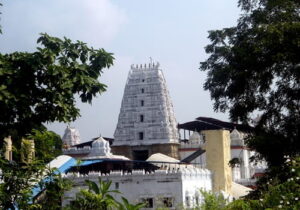
| Maa Johura Temple | English Bazar area | Hindu tradition | Popular local temple; peaceful atmosphere |
Gambhira — Malda’s Unique Folk Tradition
Gambhira is a socio-religious folk performance tradition that originated in Malda district and has no direct equivalent anywhere else in Bengal. Performed by male artists in colourful costumes and wooden masks, Gambhira combines devotional worship of Lord Shiva with sharp social commentary — performers act out the concerns and grievances of ordinary people before the deity, who is expected to hear and respond. The festival begins at the end of the Bengali month of Chaitra (March–April), marking the end of the agricultural harvest.
The masks used in Gambhira performances — large, painted, expressive — are themselves an art form. The combination of worship, satire, folk music, and masked performance makes Gambhira one of the most distinctive cultural experiences in West Bengal. If your travel dates align with the Chaitra festival, this is not optional — it defines what Malda actually means to the people who live in it.
Weather in Malda District — Season by Season
Malda has a tropical climate influenced by its position in the Gangetic delta region. Summers are harsh, monsoon is heavy, and winter brings a genuine chill that makes November to February genuinely pleasant.
October to March — Best Time to Visit
This is the clear recommendation. October brings post-monsoon relief — the countryside is green, the air is clear, and the ruins at Gaur and Pandua are at their most atmospheric. November to February sees temperatures between 8°C and 22°C — cool enough for extended outdoor exploration of the archaeological sites. December and January mornings can be genuinely cold; carry layers. The Gambhira festival falls in March–April — an excellent reason to extend the visit toward that window.
June to September — Monsoon
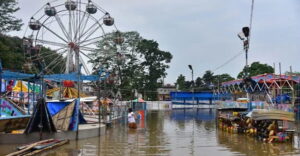
Malda receives substantial monsoon rainfall. The Mahananda river swells, low-lying areas near the archaeological sites can become waterlogged, and access to some of the Gaur monuments on unpaved paths becomes difficult. The landscape is intensely green and photogenic for those who don’t mind the rain. The Gaur monuments in soft monsoon light have a particular atmosphere.
April to May — Summer and Mango Season
Temperatures climb to 38–42°C and the heat is intense. However, May and June are the peak of the mango season — Fazli mangoes and the earlier Laxmanbhog, Gopalbhog, and Himsagar varieties are harvested during this period. For a traveller with a genuine interest in this dimension of Malda, summer is actually a worthwhile time to visit — confine sightseeing to mornings, and spend the rest of the day in the orchards and markets.
Things to Do in Malda District (2026)
Do the Full Gaur Circuit by Car — Hire a car from English Bazar for the day. The major monuments — Dakhil Darwaza, Bara Sona Mosque, Firoz Minar, Qadam Rasul Mosque, Lattan Mosque, Gomti Gate — are distributed over several kilometres. Some connecting roads near the Bangladesh border can be rough; a local driver who knows the site is worth the cost.
Visit the Malda Museum First — Spend 90 minutes in the museum before going to the ruins. The Pala-era sculpture collection and the contextual historical displays make the ruins significantly more meaningful.
Explore Pandua — Pandua is 18 km from English Bazar and is often skipped in favour of the better-known Gaur. Don’t skip it. The Adina Mosque ruins are vast, evocative, and almost always quiet. The Eklakhi Mausoleum nearby is one of the best-preserved medieval structures in the district.
Visit Ramkeli — A short stop that rewards anyone with any connection to the Chaitanya Vaishnava tradition — or anyone who simply appreciates the atmosphere of a village built around a 500-year-old sacred tree.
Attend the Gambhira Festival — If visiting in late March or early April, find out the local schedule for Gambhira performances. The masked performances before local Shiva shrines are genuine folk art in their natural context — not a staged cultural show.
Eat the Mangoes and Buy the Silk — Malda’s Fazli mangoes are genuinely among the best in India. Between May and July, they are sold everywhere and cost a fraction of what they fetch in Kolkata. The Tussar silk sarees produced in the district — particularly those used as bases for Kantha embroidery — are available in the local markets at source prices.
How to Reach Malda District
By Air: Bagdogra Airport (IXB) near Siliguri is the nearest major airport, approximately 230 km away. The journey to Malda from Bagdogra takes 4 to 5 hours by car. No direct flights operate into Malda.
By Train: Malda Town Railway Station is the divisional headquarters of Eastern Railways’ Malda Division — a major junction with direct connections to Kolkata (approximately 5 to 6 hours), New Jalpaiguri, Guwahati, Patna, and other major cities.
By Road: National Highway 34 (now re-designated NH 12) passes through the district, connecting Malda to Kolkata (approximately 347 km, 6 to 7 hours) and Siliguri (approximately 256 km). NBSTC, SBSTC, and private buses run frequently from Kolkata and Siliguri. CSTC services are also available from Kolkata.
Practical Tips for Visitors (2026)
- Carry sufficient water and food for the Gaur circuit — there are no reliable restaurants within the monument zone, only basic village eateries.
- Some sections of Gaur near the Bangladesh border require caution — stay within the ASI-marked monument zone and follow local guidance.
- The Malda Museum is closed on Mondays — plan accordingly.
- Carry cash; digital payment acceptance is limited at most heritage sites and local markets.
- The road between Pandua and Malda is good quality; the internal roads within Gaur vary — confirm approach road conditions with your driver before setting out.
- Early morning visits to the monuments avoid the worst heat and provide the best photographic light.
Conclusion
Malda does not make its case loudly. The ruins of Gaur sit behind mango orchards on the Bangladesh border, accessible but not promoted with the vigour they deserve. The Adina Mosque at Pandua — which was once one of the largest mosques in Asia — is visited by a fraction of the tourists who go to less significant medieval sites elsewhere in India. The Pala sculpture in the Malda Museum quietly rivals Buddhist art collections in far better-known institutions.
That gap between actual significance and popular recognition is, for the right kind of traveller, the most compelling reason to visit in 2026. Malda is a district of genuine archaeological depth, living cultural traditions, extraordinary fruit, and extraordinary ruins — a combination that very few places in India can honestly claim.
FAQs About Malda District, West Bengal
Q: What is Malda famous for?
A: Malda is famous for the medieval ruins of Gaur and Pandua — the former capitals of the Bengal Sultanate — the Fazli mango (one of India’s finest mango varieties), Tussar silk production, and the unique folk tradition of Gambhira. The Dakhil Darwaza (1425 AD) and Adina Mosque are the most significant heritage monuments.
Q: How far is Malda from Kolkata?
A: Malda is approximately 347 km north of Kolkata by road and roughly 365 km by rail. The train journey takes 5 to 6 hours; the road journey 6 to 7 hours.
Q: What is the best time to visit Malda?
A: October to March is ideal for sightseeing. November to February offers the most comfortable temperatures for exploring the outdoor monuments at Gaur and Pandua. For the mango season, May to June is the peak, despite the heat. The Gambhira festival in March–April is a cultural highlight.
Q: Can Gaur and Pandua be visited in one day?
A: Yes, comfortably. Hire a car from English Bazar for the day. Start with the Malda Museum in the morning, then Pandua (Adina Mosque, Eklakhi Mausoleum), then the Gaur circuit in the afternoon. Allow 7 to 8 hours total.
Q: Is Malda safe for tourists?
A: Malda is generally safe for tourists. The monument areas are maintained by ASI. Exercise standard precautions near the Bangladesh border zone within Gaur — stay within the signposted areas and don’t attempt to approach the border crossing on foot without proper documentation.