Madhubani District, Bihar: Mithila Painting, Tourist Places, Temples, History & Travel Guide
The name itself is a destination. Madhubani — “forest of honey” in Sanskrit — conjures the district’s identity before you even arrive. But what actually defines Madhubani is not honey or forests. It is paint. Specifically, it is a 2,500-year-old tradition of painting practised by women of the Mithila region of Bihar and Nepal, using natural pigments on mud walls, cloth, and paper, in a visual language so distinctive and so beautiful that it has been accorded Geographical Indication status, exhibited in museums from New Delhi to Japan, and recognised by UNESCO’s Intangible Cultural Heritage framework.
The paintings are everywhere in Madhubani. On the walls of houses in villages like Jitwarpur and Ranti. On the walls of the railway station — one of the most photographed station murals in India. On the sarees and canvases sold at the market. And on the hands and walls of women who have learned the tradition from their mothers and grandmothers across generations, using natural dyes made from rice paste, turmeric, indigo, and lampblack in compositions of gods and goddesses, fish and lotus, wedding rituals and cosmic diagrams.
Madhubani district was carved from Darbhanga in 1972. It sits at the geographical centre of what was once the ancient Mithila kingdom, bordered by Nepal to the north, Darbhanga to the south, Sitamarhi to the west, and Supaul to the east. Beyond the art, the district holds ancient temples, a ruined royal palace of considerable grandeur, an important Mithila archaeological site, and a Brahmin marriage-negotiation tradition that has operated in the same village for centuries.
Madhubani District, Bihar — Quick Overview
| Feature | Details |
| State | Bihar |
| District Headquarters | Madhubani town |
| Division | Darbhanga Division |
| District Formed | 1972 (carved from Darbhanga district) |
| Area | 3,501 sq km |
| Borders | Nepal (N), Darbhanga (S), Sitamarhi (W), Supaul (E) |
| Famous For | Madhubani / Mithila painting (GI-tagged folk art), Navlakha Palace, Kapileshwar Temple, Saurath Sabha |
| Key Rivers | Kamla, Kosi, Bagmati, Thumne |
| Nearest Airport | Darbhanga Airport (DBR) (~30 km) / Janakpur Airport, Nepal (~nearby border) |
| Railway Station | Madhubani Railway Station; Sakri Junction; Jhanjharpur Junction; Rajnagar Station |
| Best Time to Visit | October to March |
| Summer Temperature | 28°C – 42°C |
| Winter Temperature | 5°C – 20°C |
| Languages Spoken | Maithili (primary), Hindi, Urdu |
| Key Blocks | Madhubani, Rajnagar, Jhanjharpur, Pandaul, Benipatti, Phulparas |
History of Madhubani District
The Ancient Mithila Kingdom
Madhubani sits at the heart of one of ancient India’s most culturally distinguished regions. Mithila — the kingdom of the Videhas, ruled by the legendary Janakas — was one of the major political and intellectual centres of the late Vedic period (approximately 1100–500 BCE). It was in Mithila that the philosophical dialogues of the Brihadaranyaka Upanishad reportedly took place, and the Janaka kings were patrons of the kind of rigorous intellectual debate that shaped early Indian philosophy.
The Ramayana places Mithila as the birthplace of Sita, daughter of King Janaka of Janakpur. It is this connection — and specifically the tradition that Janaka commissioned the first Madhubani paintings to celebrate Sita’s marriage to Ram — that gives the art form its legendary origin. The tradition has been practised continuously in the women’s quarters of Mithila households across at least 2,500 years, surviving the fall of kingdoms, the arrival of new rulers, and the partition of 1947 entirely through domestic transmission from mother to daughter.
Balirajgarh, an archaeological site in the district, is believed to have been the capital city of the ancient Mithila Kingdom — though formal excavation remains limited and the site’s full historical profile is yet to be established.
Medieval and Modern History
The district remained within the Mithila cultural zone through the medieval period, coming under the influence of the Karnata dynasty and later the Oinwar dynasty of Tirhut — rulers who patronised Maithili literature and poetry. The great poet Vidyapati (14th–15th century) — whose compositions in Maithili are considered classics of medieval Indian literature — is closely associated with this region. The village of Pandaul in Madhubani district is associated with Vidyapati.
During the colonial period, the Darbhanga Raj — a powerful Maithil Brahmin zamindari estate — administered much of the Mithila region including present-day Madhubani. It was within this zamindari that Navlakha Palace at Rajnagar was constructed. The 1934 Bihar-Nepal earthquake caused significant damage to the palace complex, much of which was never rebuilt.
Madhubani painting was effectively discovered by the outside world in 1934 — ironically, through that same earthquake. A British colonial officer examining earthquake damage noticed extraordinary paintings on the interior walls of village homes and brought them to wider attention. The art’s journey from village mud walls to international museums and galleries began there.
The district was formally carved from Darbhanga in 1972 as part of Bihar’s district reorganisation.
Top Attractions in Madhubani District
Madhubani Painting — The Living Art Tradition
The art itself is the primary reason most visitors come to Madhubani, and rightly so. Madhubani painting (also called Mithila painting) is a GI-tagged folk art tradition practised across the district’s villages, characterised by:
Geometric precision combined with organic symbolism. Natural dyes and pigments — rice paste for white, turmeric for yellow, indigo for blue, lampblack for black, red from natural plant sources. Two-dimensional imagery with figures shown simultaneously from front and profile. Subjects drawn from Hindu mythology (gods and goddesses, scenes from the Ramayana and Mahabharata), nature (fish, lotus, sun, moon, bamboo), and life events (births, marriages, festivals). No empty space — every part of the composition is filled.
The art was practised traditionally on freshly plastered mud walls by women of the household for religious occasions, festivals, and life events. Today it is also produced on handmade paper, cloth, canvas, and other surfaces, and has developed into a significant rural craft economy.
Jitwarpur village, about 3 km from Madhubani town, is one of the most important centres for authentic Madhubani painting, with artists from multiple communities working in their homes. Walking through Jitwarpur — watching painters at work, seeing compositions in progress, understanding the different school styles (Brahmin, Kayastha, and Dusadh traditions each have distinct visual vocabularies) — is the most direct experience the district offers.
Ranti village is similarly celebrated as an art centre. The Mithila Art Institute in Madhubani town provides historical context, hosts workshops, and offers the opportunity to learn basic techniques from practising artists.
Navlakha Palace — Rajnagar
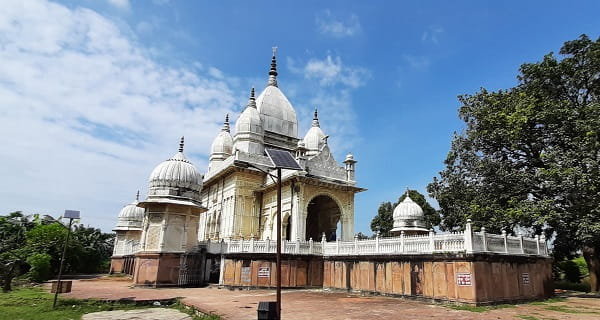
About 12 km east of Madhubani town on the banks of the Kamla River in Rajnagar, the Navlakha Palace (also called Rajnagar Palace) is one of Bihar’s most significant and most underappreciated historic monuments. Built between 1884 and 1929 by Maharaja Rameshwar Singh — younger brother of the Darbhanga Maharaja — to serve as the administrative capital of the Darbhanga Raj’s eastern territory, the palace spreads across approximately 1,500 acres.
The palace complex contains 11 temples dedicated to various gods and goddesses, paved gardens, ornamental ponds, temple complexes, and multiple palaces and forts. Its portico is supported by four stone arches carved on stone elephants. The 1934 Bihar-Nepal earthquake inflicted serious damage that was never fully repaired — the complex today is partially ruined and partially occupied by government institutions including an SSB (Sashastra Seema Bal) training camp and educational facilities.
Several museums within the Navlakha Palace campus remain — a tea museum, toy museum, horse carriage museum, and doll museum — and the palace houses what is described as the oldest surviving example of Mithila painting, giving it direct connection to the district’s primary cultural identity. The seven-storey central palace structure with its Durga Bhawan at the entrance retains considerable grandeur despite the earthquake damage and years of limited maintenance.
Kapileshwar Sthan Temple
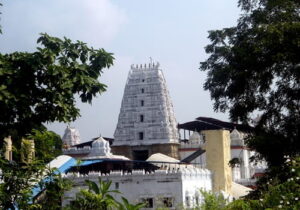
Located 9 km from Madhubani town, the village of Kapileshwar Sthan is named for and centred on the Kapileshwar Temple — one of the most important Shiva temples in the district. The Shivalinga here is believed to have been installed by the sage Kapila himself. The temple sits within a large compound containing subsidiary shrines to Parvati, Hanuman, and other deities, and has a large pond from which devotees draw water for the Shivalinga abhishek.
Devotees congregate here particularly on every Monday and throughout the holy month of Shravan, when the influx from across Bihar is substantial. The Maha Shivratri fair at Kapileshwar Sthan is one of the district’s largest annual gatherings. The temple’s carved pillars and serene courtyard atmosphere reward even those visiting primarily as travellers rather than pilgrims.
Saurath — Somnath Mahadev Temple and the Sabha
The village of Saurath, on the road from Madhubani to Jaynagar, holds two distinct identities simultaneously. It is home to the Somnath Mahadev Temple — an ancient Shiva shrine — and it is also the site of the Saurath Sabha, the annual gathering of Maithili Brahmins that is one of the most unusual community institutions in Bihar.
The Saurath Sabha is an annual marriage-negotiation market. For centuries, Maithili Brahmin families have brought their unmarried sons to Saurath during the meeting season, and panjikars (keepers of genealogical records for different families) facilitate the matching of prospective brides and grooms by cross-referencing family lineages, horoscopes, and social compatibility. The tradition is deeply embedded in Maithil Brahmin social structure. Many panjikars who maintain these genealogical records reside in Saurath and the surrounding villages. Walking through the sabha during the season — typically held in the Jyaistha month (May–June) — is one of the most socially distinctive experiences in the district.
Uchaitha — Bhagwati Temple and Kalidas Connection
The Uchaitha Bhagwati Temple in Benipatti block sits on the western bank of the river Thumne. The temple is dedicated to Goddess Bhagwati and carries a remarkable literary association — local tradition holds that the great Sanskrit poet and dramatist Kalidas received divine blessing from the Goddess at this spot, inspiring his celebrated compositions. Whether or not one accepts the legend, the temple is ancient, its riverside setting is genuinely peaceful, and the association with one of India’s greatest classical writers gives it a significance beyond local pilgrimage.
A large fair is held at Uchaitha during the Navratri festival season, drawing devotees from across Madhubani and neighbouring districts.
Balirajgarh — Ancient Mithila Capital
Balirajgarh, believed to have been the capital city of the ancient Mithila Kingdom, is an archaeological site within Madhubani district. Though formal large-scale excavation remains limited, the earthen mound structure of the site suggests the outlines of a significant ancient settlement. For visitors interested in the archaeology of the Mithila region — and in the connection between this landscape and the Janaka kings of the Ramayana — Balirajgarh offers a contemplative if under-developed encounter with deep history.
Madhubani Railway Station Murals
A practical note worth including as an attraction in its own right: Madhubani Railway Station has been transformed into one of India’s most visually striking railway stations through a large-scale Mithila painting project covering its walls. The murals — depicting gods, festivals, natural motifs, and mythological scenes in the full Madhubani visual vocabulary — have become one of the most shared images from Bihar on social media. Arriving by train and walking out through this painted station is itself a memorable introduction to the district.
Temples of Madhubani District
| Temple | Location | Deity | Key Feature |
| Kapileshwar Sthan Temple | Kapileshwar village, 9 km from HQ | Lord Shiva | Shivalinga installed by sage Kapila; large Shravan and Shivratri gatherings |
| Somnath Mahadev Temple | Saurath, Madhubani–Jaynagar road | Lord Shiva | Ancient Shiva shrine; adjacent to the famous Saurath Sabha marriage market |
| Uchaitha Bhagwati Temple | Uchaitha, Benipatti block, Thumne riverbank | Goddess Bhagwati | Associated with Sanskrit poet Kalidas receiving divine inspiration; Navratri fair |
| Navlakha Palace Temples (11 shrines) | Rajnagar, ~12 km from HQ | Multiple deities | 11 temples within the palace complex including Durga Bhawan at entrance |
| Parasmaninath Temple | Rahua Sangram, Madhubani | Jain tradition | Active Jain pilgrimage temple; maintained by Parasmani Foundation |
| Tileshwar Mahadev Temple | Tilakpur village, Harraiya-area | Lord Shiva | Village temple known for spiritual atmosphere in the Mithila plains |
Madhubani Painting — A Deeper Look
Schools and Styles
Madhubani painting is not a single uniform style — it contains distinct sub-traditions based on community and content:
The Brahmin school is characterised by fine, detailed linework and religious subjects. The Kayastha school uses thicker lines and a broader narrative range. The Dusadh tradition (associated with the Dusadh community) produces the distinctive Kohbar style — bold, earthy, and focused on fertility and nature symbols. Each school uses different colour palettes and compositional conventions.
The 1934 Earthquake Discovery
The paintings were practised entirely within domestic spaces until 1934, when a British colonial officer named William Archer, inspecting earthquake damage in Madhubani, noticed the extraordinary wall paintings inside village homes and published essays about them. This brought the art to outside attention for the first time. Systematic encouragement of the art form began in the 1960s during a Bihar drought, when the All India Handicrafts Board encouraged women artists to paint on paper as an income-generating activity — a decision that transformed the art from a purely ritual domestic practice into an economic and international cultural phenomenon.
GI Tag and International Recognition
Madhubani painting received its Geographical Indication tag in 2007, protecting the name and establishing quality standards. A museum in Japan is dedicated to Mithila art and holds approximately 15,000 samples. The art has been exhibited across Europe, the Americas, and Asia, and Madhubani-trained artists have been invited to international residencies and galleries worldwide.
Weather in Madhubani District — Season by Season
Madhubani has a humid subtropical climate influenced by its proximity to the Himalayan foothills and the river systems of the Kosi-Kamla drainage. Summers are hot and humid; winters are cool with occasional fog; monsoon is heavy.
October to March — Best Time to Visit
The best window without qualification. October brings post-monsoon relief and the landscape — watered by the Kosi and Kamla rivers — is at its most verdant. November through February is the ideal sightseeing period with temperatures between 5°C and 20°C, clear skies, and comfortable conditions for village walks and temple visits. The Maha Shivratri fair at Kapileshwar Sthan typically falls in February–March. Chhath Puja in October–November adds extraordinary cultural colour to the district if travel dates align.
June to September — Monsoon
The monsoon brings heavy rainfall and the rivers of the district — particularly the Kosi, which has historically shifted course dramatically — can flood significantly. Rural road access becomes unreliable. The landscape is spectacularly green. Art production in the villages continues regardless of weather, and indoor painting workshops can be arranged during this period.
April to May — Summer
Temperatures climb rapidly to 38–42°C. Humid heat makes outdoor village walks and temple hill climbs uncomfortable in the middle of the day. Early morning and late afternoon visits to Kapileshwar Sthan, Saurath, and Jitwarpur village are manageable. This is not the recommended season unless the Saurath Sabha (May–June) is the specific goal.
Things to Do in Madhubani District (2026)
Walk Through Jitwarpur Village — Plan at least 2 hours in the painting village nearest to Madhubani town. Watch artists at work, understand the different community styles, and purchase directly from artists at source prices rather than from middlemen in distant cities.
Visit the Mithila Art Institute — Start here for historical context before going to the villages. Workshop bookings allow hands-on painting experience with instruction from practising artists.
See the Navlakha Palace — Allow a full morning. The combination of the ruined palace architecture, the 11 temple complex, the surviving museum collections, and the knowledge that the oldest Mithila painting exists here gives the visit genuine depth. Hire a local guide from Rajnagar town.
Visit Kapileshwar Sthan on a Monday Morning — The temple is most alive during Monday prayers and throughout Shravan (July–August). For a non-religious visitor, the ceremonial atmosphere of the morning abhishek at the Shivalinga is worth experiencing regardless.
Attend the Saurath Sabha — If visiting in the Jyaistha month (May–June), the marriage-negotiation gathering at Saurath is one of the most culturally specific experiences in Bihar. Nothing else in the district — or perhaps in the country — resembles it.
Explore Uchaitha on the Thumne Riverbank — The Bhagwati temple at Uchaitha is quieter than Kapileshwar Sthan and the riverbank setting is genuinely peaceful. The Kalidas literary connection gives the place a specific appeal for those interested in Sanskrit literature.
Shop at the Madhubani Market — The district’s main market is the best place to buy authentic Madhubani paintings, Mithila silkwork, and traditional Maithili textiles at prices that reflect the actual local economy rather than premium tourist markup.
Visit Balirajgarh — A contemplative half-day for the archaeologically curious. The site is underdeveloped, which means there are no visitor crowds, no queues, and no entrance fees — just an ancient earthen mound and the knowledge of what it is believed to represent.
How to Reach Madhubani District
By Air: Darbhanga Airport (DBR) is the nearest commercial airport, approximately 30 km from Madhubani town, and has seen significant expansion of domestic routes in recent years — check current connections from Delhi, Kolkata, and Mumbai before planning. Patna airport is approximately 170 km away by road.
By Train: Madhubani Railway Station is on the Sakri–Jaynagar branch of the Northeast Frontier Railway. Sakri Junction connects to Darbhanga Junction and onward to the main rail network. Multiple trains connect Madhubani to Darbhanga, Patna, Kolkata, and beyond.
By Road: Madhubani is approximately 170 km from Patna via NH 27 (approximately 4 to 5 hours). Darbhanga is approximately 45 km away and serves as the main regional transport hub. Regular bus services connect Madhubani to Darbhanga, Sitamarhi, Supaul, and Patna.
Practical Tips for Visitors (2026)
- For authentic Madhubani paintings, buy directly from village artists in Jitwarpur or Ranti — the price differential from city galleries and online markets is significant, and the quality assessment is more straightforward when you can watch the artist work.
- Carry cash. Village purchases, auto-rickshaw rides, and smaller temple donations all require physical rupees.
- The Navlakha Palace is partially occupied by government institutions — entry to some sections may require prior coordination; confirm access arrangements locally in Rajnagar.
- Madhubani Railway Station murals are best photographed in the morning light before the platforms become crowded.
- Maithili is the primary local language; basic Hindi is sufficient for most visitor interactions but a local guide from the district tourism office adds considerably to village art visits.
- Try litti-chokha and local Maithili cuisine in the main market — the district’s food culture is a less-celebrated but genuinely rewarding dimension of the visit.
Conclusion
Madhubani is one of those rare places where a single art form has preserved an entire civilisation’s visual memory. The Mithila painting tradition carries within its geometric patterns and mythological compositions an unbroken record of how the women of this region have seen the world, celebrated life’s passages, and communicated with the divine across 2,500 years. That is not marketing language — it is what the archaeological and cultural evidence supports.
The Navlakha Palace adds royal history. Kapileshwar Sthan adds Shaivite devotion. The Saurath Sabha adds social anthropology that has no equivalent anywhere else in the country. Balirajgarh adds ancient political geography. Together, they make Madhubani a district that rewards a traveller willing to engage with all its dimensions — not just the paintings on paper sold at the airport, but the living tradition on the walls of village homes where it has always belonged.
FAQs About Madhubani District, Bihar
Q: What is Madhubani famous for?
A: Madhubani is famous worldwide for Madhubani painting (also called Mithila painting) — a 2,500-year-old GI-tagged folk art tradition practised by women of the Mithila region using natural dyes on mud walls, cloth, and paper. The district is also known for Navlakha Palace at Rajnagar, the Kapileshwar Sthan Shiva temple, the Saurath Sabha marriage market tradition, and the Uchaitha Bhagwati Temple.
Q: Where can I see authentic Madhubani paintings?
A: The best place to see authentic Madhubani paintings being made is in the villages of Jitwarpur (3 km from Madhubani town) and Ranti. The Mithila Art Institute in Madhubani town offers workshops and exhibitions. Madhubani Railway Station has extensive mural paintings covering its walls. Purchasing directly from village artists is the most authentic and economically fair option.
Q: How far is Madhubani from Patna?
A: Madhubani is approximately 170 km from Patna via NH 27, a drive of roughly 4 to 5 hours. Darbhanga, approximately 45 km away, is the nearest major rail junction with better connectivity to Patna and other cities.
Q: When was Madhubani painting given GI tag?
A: Madhubani painting received its Geographical Indication (GI) tag in 2007, protecting the name and establishing quality standards for authentic Mithila art.
Q: What is the Saurath Sabha?
A: The Saurath Sabha is an annual gathering of Maithili Brahmin families in the village of Saurath, Madhubani district, held during the Jyaistha month (May–June). It is a centuries-old institution for negotiating marriages within the community, facilitated by panjikars (genealogical record keepers) who cross-reference family lineages and horoscopes. It is one of the most distinctive social traditions in Bihar and has no equivalent elsewhere in India.