Mathura District, Uttar Pradesh: Top Attractions, History, Temples, Weather & Things to Do
Mathura district occupies a position of supreme significance in Hindu tradition as one of the seven holy Sapta Puri cities, alongside Ayodhya, Haridwar, Varanasi, Kanchipuram, Ujjain, and Dwarka. Situated on the banks of the river Yamuna, Mathura is universally known as the birthplace of Lord Krishna and forms the heart of Brajbhoomi — the sacred land encompassing the entirety of Krishna’s mythological life, from his dramatic birth in a prison cell to his playful childhood in nearby Vrindavan.
The district’s history reaches back to the epic age: in the Ramayana, the Ikshwaku prince Shatrughna slays the demon Lavanasura and claims the land, which subsequently became known as Madhuvan (for its dense forests), then Madhupura, and finally Mathura. By the 6th century BCE, Mathura had become the capital of the kingdom of Surasena, ruled by Kansa — Krishna’s tyrannical maternal uncle. Beyond its devotional core, ancient Mathura flourished as a major artistic centre from the 2nd century BCE, producing devotional icons for Buddhism, Jainism, and Hinduism simultaneously — a remarkable testament to religious tolerance and creative exchange that predates the city’s modern identity as one of India’s most visited pilgrimage destinations.
Mathura District, Uttar Pradesh — Quick Overview
| Feature | Details |
| State | Uttar Pradesh |
| District Headquarters | Mathura city |
| Religious Status | One of seven Sapta Puri (holy cities) of Hinduism |
| Twin City | Vrindavan |
| Famous For | Krishna Janmabhoomi, Dwarkadhish Temple, Banke Bihari Temple, Prem Mandir, Vishram Ghat |
| Ancient Names | Madhuvan, Madhupura, Mathura |
| Ancient Kingdom | Surasena (capital from 6th century BCE) |
| Distance from Delhi | ~155 km |
| Distance from Agra | ~70 km |
| Nearest Airport | Agra Airport (limited flights); Delhi (better connectivity) |
| Best Time to Visit | October to March |
History of Mathura District
1. The Ramayana Connection
In the epic Ramayana, the Ikshwaku prince Shatrughna (Lord Rama’s youngest brother) slays a demon named Lavanasura and claims the surrounding land. Because the area was thickly wooded at the time, it came to be known as Madhuvan, subsequently evolving to Madhupura, and finally settling as Mathura — the name by which the sacred city has been known for millennia.
2. Capital of Surasena and the Reign of Kansa
By the 6th century BCE, Mathura had become the capital of the kingdom of Surasena, ruled by Kansa, the maternal uncle of Lord Krishna. According to Hindu tradition, Kansa imprisoned his sister Devaki and her husband Vasudeva after a prophecy foretold that their eighth son would bring about his death — setting the stage for Krishna’s miraculous birth within this very prison cell, an event that forms the central devotional narrative of Mathura’s identity today.
3. Mathura Art — A Centre of Religious Tolerance
Dating back to the 2nd century BCE, Mathura art thrived during a period when Buddhism, Jainism, and Hinduism flourished simultaneously in the region. The city earned distinction as the “first artistic centre to produce devotional icons for all three faiths,” showcasing a remarkable degree of religious tolerance and creative exchange that distinguished ancient Mathura from many other contemporary centres of civilisation. This artistic legacy spans the Mauryan and Kushan periods, with sculptures, pottery, paintings, and coins from this era preserved at the city’s Government Museum, established in 1874.
4. Vrindavan’s Rediscovery by Chaitanya Mahaprabhu
While Vrindavan is said to be the place where Lord Krishna spent his childhood, the holy town’s modern devotional prominence owes significantly to Chaitanya Mahaprabhu, the great Bengali Vaishnava saint credited with rediscovering Vrindavan centuries after its original sacred sites had become obscured. The town was subsequently developed by various regional kings, and the name “Vrindavan” itself derives from “vrinda” (meaning tulsi or basil) and “van” (meaning grove), most likely referencing the sacred groves at Nidhivan and Seva Kunj.
Top Attractions in Mathura District
1. Shri Krishna Janmabhoomi Temple
The most significant site in Mathura, the Krishna Janmabhoomi Temple is built around the prison cell (Garbha Griha) where Lord Krishna’s parents, Devaki and Vasudeva, were imprisoned by Kansa, and where Krishna is believed to have manifested himself, liberating his parents from tyranny. Adjacent to the prison cell stands a temple dedicated to Maa Yogmaya. The space is intentionally understated rather than visually grand — devotees stand quietly in long queues, chants echo softly, and the atmosphere remains restrained and solemn. Modest clothing is expected, footwear must be removed, and the temple draws massive crowds particularly during Janmashtami.
2. Dwarkadhish Temple
Built in 1814, the Dwarkadhish Temple is dedicated to Lord Krishna in his majestic adult form as the King of Dwarka. The temple houses a captivating black marble idol of Krishna alongside a white marble idol of Sri Radharani, with detailed carvings and vibrant wall paintings reflecting a fusion of Rajput and Mughal architectural styles. Unlike the restrained mood at Janmabhoomi, Dwarkadhish feels genuinely celebratory, with the morning Mangala Aarti and evening Sandhya Aarti drawing large, enthusiastic crowds.
3. Banke Bihari Temple, Vrindavan
One of Vrindavan’s most beloved temples, Banke Bihari was founded by Swami Haridas, a devotee of Krishna, with the deity’s idol originally worshipped in Nidhivan before being relocated to the present temple. The temple follows a unique tradition called Jhanki Darshan — a curtain is drawn in front of the idol every 1-2 minutes, believed to prevent Bihari Ji from following a devotee’s unwavering gaze and leaving the temple. Thakurji is worshipped here like a small child, which is why the morning Mangala Aarti (which would “wake” him) is not performed. The temple, built in Rajasthani architectural style with carved arched ceilings, features the deity decorated in an elaborate floral structure called “Phool Bangla Seva.”
4. Prem Mandir
Shaped by Jagadguru Shri Kripaluji Maharaj in 2001 and built on 54 acres of land, standing about 125 feet high, Prem Mandir (Temple of God’s Love) is dedicated to both Radha-Krishna and Ram-Sita. Located in Vrindavan, this newly constructed temple is widely considered the most visually stunning in the entire Braj region, becoming particularly crowded with devotees during the elaborate evening Aarti.
5. Vishram Ghat
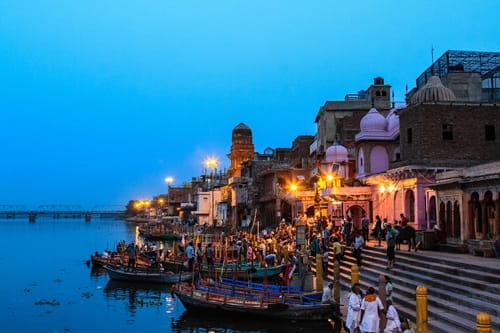
The most prominent and significant of Mathura’s 25 ghats along the Yamuna, Vishram Ghat is believed to be the spot where Krishna rested after defeating his demon uncle Kansa — its name literally meaning “ghat of rest.” The site marks both the beginning and end of the traditional Mathura parikrama (pilgrimage circuit), with the evening Yamuna Aarti around 7 PM creating a genuinely sacred atmosphere through oil lamps, floating diyas, and rhythmic chants.
6. Govardhan Hill (Giri Raj)
Located 22 km from Vrindavan, Govardhan Hill holds profound theological significance — the Bhagavad Gita states that, according to Lord Krishna, Govardhan Parvat is not different from himself, meaning devotees worship the hill’s sandstone rocks just as they would worship his idol directly. The hill stands 80 feet tall with a circumference of 38 km, and the parikrama circuit includes notable sites like Mansi Ganga, Mukharvind, and Daan Ghati.
7. Barsana
Located 45-48 km from Mathura and Vrindavan, Barsana is the birthplace of Radha, Krishna’s consort, surrounded by hills on four sides (earlier named Brahmsarin, after the legend that Krishna asked Brahma to take the form of these hills). The most celebrated temple here is the Radha Rani Temple (also called Ladli ji Temple or Shriji Temple), built in 1675 by Raja Bir Singh Ju Deo of Orchha, with some sources attributing construction to Narayan Bhatt, a disciple of Chaitanya Mahaprabhu. The village’s Prem Sarovar tank is believed to mark the first meeting place of Krishna and Radha, and Barsana becomes especially vibrant during the Holi festival.
8. Kusum Sarovar
Located between Govardhan and Radha Kund, 25-26 km from both Vrindavan and Mathura, Kusum Sarovar is a 450-foot-long, 60-foot-deep tank dating to the period of Lord Krishna himself, featuring flights of stairs on all sides. The tank is believed to be where Radha and her gopikas (cowherd maidens) collected flowers and met Krishna; during Chaitanya Mahaprabhu’s era it was known as Sumanah Sarovar, and the Chaitanya Charitamrita states Chaitanya himself bathed here.
9. Radha Kund and Shyam Kund
Situated near Govardhan Hill, these two adjacent holy water tanks are considered among the supreme sacred sites of Braj, containing pure water believed to possess magical properties for conception — a particularly significant devotional belief for couples seeking children.
10. Kans Qila
An ancient fortress dedicated to Kansa, Krishna’s maternal uncle, situated on the northern banks of the Yamuna near Krishna Ganga Ghat and Gau Ghat. The fort displays a fusion of Hindu-Muslim architecture and, despite being in a dilapidated state due to neglect, remains a popular tourist site for those interested in Mathura’s pre-devotional dynastic history.
11. Government Museum, Mathura
Constructed in 1874, this museum holds a fine collection of art, paintings, transcripts, and ancient pottery dating back to the 3rd century BCE, including significant archaeological treasures from the Mauryan and Kushan periods — sculptures, intricate pottery, weathered coins, and more, documenting Mathura’s role as one of ancient India’s great artistic centres.
Temples of Mathura District
| Temple | Location | Deity | Key Feature |
| Shri Krishna Janmabhoomi Temple | Mathura | Lord Krishna | Built around Krishna’s prison-cell birthplace |
| Dwarkadhish Temple | Mathura | Lord Krishna (King of Dwarka) | Built 1814; black marble idol; Rajput-Mughal fusion |
| Banke Bihari Temple | Vrindavan | Lord Krishna | Jhanki Darshan curtain tradition; founded by Swami Haridas |
| Prem Mandir | Vrindavan | Radha-Krishna, Ram-Sita | Built 2001; 125 feet tall; most visually grand in Braj |
| Radha Rani Temple (Ladli ji) | Barsana | Radha | Built 1675; Radha’s birthplace; major Holi celebration |
| ISKCON Temple (Krishna Balaram Mandir) | Vrindavan | Krishna-Balaram | Raman Reti area; Hare Krishna global significance |
| Govind Dev Temple | Vrindavan | Lord Krishna | One of the oldest and most historic Vrindavan temples |
| Radha Raman Temple | Vrindavan | Radha Raman (Krishna) | Early modern period; significant devotional site |
Weather in Mathura District
October to March — Best Time: Pleasant, cool weather ideal for sightseeing across both Mathura and Vrindavan, with temperatures dipping further during the Krishna Janmashtami festival period.
Janmashtami Period (August-September): While outside the typical “best weather” window, this is considered the most spiritually significant time to visit, when devotion and festivities reach their peak across the district’s temples.
Summer (April-June): Hot conditions typical of the North Indian plains, making outdoor sightseeing and ghat visits less comfortable during midday hours.
Things to Do in Mathura District (2026)
Krishna Janmabhoomi Pilgrimage — Visit the sacred birthplace temple with appropriate modest dress and patience during peak hours, particularly powerful during Janmashtami.
Evening Aarti Circuit — Experience the Yamuna Aarti at Vishram Ghat (around 7 PM) followed by temple aartis at Dwarkadhish or Banke Bihari for a complete devotional evening.
Vrindavan Temple Tour — Combine Banke Bihari, Prem Mandir, ISKCON, and Govind Dev temples into a comprehensive day of Krishna devotion across Mathura’s twin city.
Govardhan Hill Parikrama — Undertake the sacred circumambulation around Govardhan Hill, visiting Mansi Ganga, Mukharvind, and Daan Ghati along the route.
Barsana Holi Festival Visit — Time a visit for Holi to experience the famous Lath Mar Holi celebrations at Radha’s birthplace.
Explore the Government Museum — Spend time examining Mauryan and Kushan-era sculptures, pottery, and coins documenting ancient Mathura’s artistic golden age.
How to Reach Mathura District
By Air: Agra Airport offers limited commercial flights; Delhi’s Indira Gandhi International Airport, approximately 155 km away, provides significantly better connectivity.
By Train: Mathura Junction is a major railway station well connected to Delhi, Agra, and major Indian cities, with Vrindavan also having its own station.
By Road: Mathura is approximately 155 km from Delhi and 70 km from Agra, making it a popular weekend getaway, well connected by national highways and regular bus services.
Conclusion
Mathura district stands as the spiritual epicentre of Krishna devotion in India — a place where the Garbha Griha birthplace prison, the celebratory Dwarkadhish Temple, the curtain-veiled Banke Bihari idol, and the soaring Prem Mandir together create one of Hinduism’s most complete devotional landscapes. Combined with Vrindavan’s childhood playgrounds, Barsana’s Radha legacy, and Govardhan Hill’s living theology, Mathura offers travellers far more than temple-hopping — it delivers an immersive journey through the entire mythological arc of Krishna’s earthly life.
FAQs About Mathura District, Uttar Pradesh
Q1. What is Mathura district famous for?
A: Mathura is famous as the birthplace of Lord Krishna and one of Hinduism’s seven holy Sapta Puri cities. The district encompasses Krishna Janmabhoomi Temple, the Dwarkadhish Temple, and its twin city Vrindavan, home to the Banke Bihari Temple, Prem Mandir, and ISKCON’s Krishna Balaram Mandir.
Q2. How did Mathura get its name?
A: According to the Ramayana, Ikshwaku prince Shatrughna slew a demon named Lavanasura and claimed the surrounding land. Because the area was densely wooded, it was first called Madhuvan, then Madhupura, and finally Mathura — the name that has persisted to this day.
Q3. What is the unique tradition at the Banke Bihari Temple?
A: Banke Bihari Temple follows the Jhanki Darshan tradition, where a curtain is drawn in front of the deity’s idol every 1-2 minutes. This is believed to have originated because Bihari Ji once followed a devotee with unwavering devotion, so the curtain was introduced to prevent him from leaving the temple by being captivated by devotees’ gazes.
Q4. What is the significance of Govardhan Hill in Krishna worship?
A: According to the Bhagavad Gita, Lord Krishna stated that Govardhan Parvat is not different from himself. As a result, devotees worship the sandstone rocks of Govardhan Hill directly, just as they would worship Krishna’s idol, making the hill itself one of the most theologically significant sites in all of Vaishnava devotion.
Q5. When is the best time to visit Mathura and Vrindavan?
A: October to March offers the most pleasant, cool weather for sightseeing across both Mathura and Vrindavan. For the most spiritually significant experience, many devotees specifically time their visit around Krishna Janmashtami (August-September), when the district’s temples and festivities reach their devotional peak despite the warmer weather.